Best Prop Firms for Beginners with Low Entry Fees
Best prop firms for beginners with low entry fees, compared on cost, rules, and payout speed, so you can start trading with less risk.
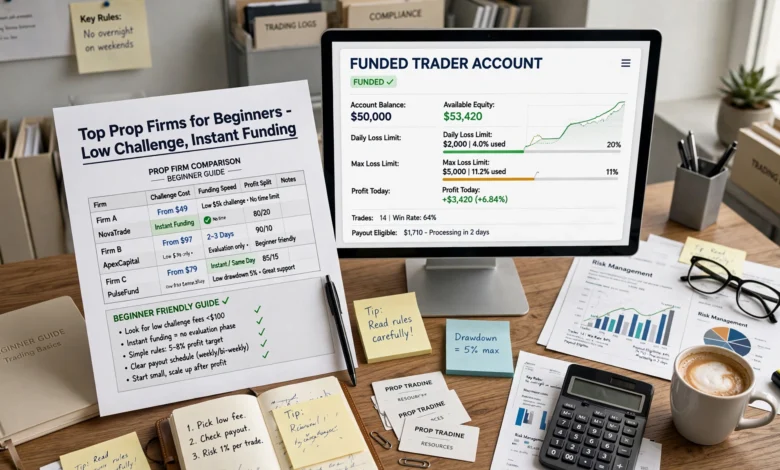
Best prop firms for beginners with low entry fees have become a lot easier to find over the past year, but that also means it’s easier to pick the wrong one. A few years ago, most funded trading programs charged $200 to $500 just to sit the evaluation, which put a lot of new traders off before they even placed a trade. That’s changed. Firms now compete on price as much as they compete on profit splits, and some evaluations start under $50.
The catch is that a cheap challenge fee doesn’t automatically mean a good deal. Some low-cost firms make up for it with tight drawdown limits, hidden reset fees, or slow payouts. If you’re new to funded trading, the goal isn’t just to find the lowest number on the pricing page. It’s to find a firm that gives you a realistic shot at passing without needing a perfect month.
This guide walks through the prop firms for beginners that currently offer the best mix of low entry cost and fair rules. I’ll cover what to look for, where firms tend to cut corners, and which programs are actually worth your money if you’re just getting started. By the end, you should be able to pick a firm with confidence instead of guessing based on a homepage banner.
What Is a Prop Firm and Why Low Entry Fees Matter for Beginners
A proprietary trading firm, or prop firm, gives traders access to its capital instead of requiring them to risk their own money. In exchange, the trader keeps a share of the profits, usually somewhere between 80% and 90%. Before you get access to real (or simulated) funded capital, most firms require you to pass an evaluation, often called a challenge, that tests whether you can trade profitably within set risk rules.
The entry fee is what you pay to attempt that evaluation. For beginners, this number matters more than it does for experienced traders, for a simple reason: you’re more likely to fail your first attempt while you’re still learning a firm’s specific rules. A trader who pays $500 and fails twice has spent $1,500 before ever getting funded. A trader who starts with a $30 to $80 evaluation can afford a few tries while they figure out position sizing and risk management.
Low entry fees also lower the psychological pressure of trading. When you’ve put your rent money on the line, you tend to overtrade or panic during drawdowns. A smaller stake keeps decision-making calmer, which, ironically, tends to produce better results.
For more background on how proprietary trading works at the institutional level, Investopedia’s overview of proprietary trading is a solid starting point.
How We Evaluated the Best Prop Firms for Beginners with Low Entry Fees
Before ranking anything, it helps to know what actually separates a beginner-friendly firm from one that just looks cheap. Here’s what was weighed for this list:
- Entry fee relative to account size – not just the sticker price, but what you get for it
- Drawdown rules – static drawdowns are generally more forgiving than trailing ones for new traders
- Evaluation structure – one-step challenges are faster, two-step challenges are often more forgiving on profit targets
- Payout reliability – firms with a track record of on-time payouts, verified through trader reviews and platforms like Trustpilot
- Hidden costs – activation fees, monthly data fees, or reset charges that inflate the real cost
- Customer support and education – how much help is available if you’re new to the process
No single factor decides the ranking. A firm with the lowest fee but a punishing trailing drawdown isn’t actually beginner-friendly, no matter what the price tag says.


7 Best Prop Firms for Beginners with Low Entry Fees in 2026
1. The5ers
The5ers has built a reputation around a progressive funding model that’s genuinely built for people starting out. Instead of demanding a large fee upfront, you pay a smaller entry cost and move through evaluation stages, with the full account balance unlocked only once you’ve proven consistency. This staged approach spreads out the financial commitment and gives beginners room to make mistakes early without losing everything at once.
Key points:
- Multiple challenge types across forex and other assets
- 1:100 leverage available
- Access to account sizes up to several million dollars as you scale
- Strong structured onboarding for new traders
2. FTMO
FTMO is one of the most recognized names in the industry, and while it’s not the absolute cheapest option, it’s often the safest starting point for a beginner who wants to avoid firms with questionable payout histories. FTMO offers up to 90% profit sharing, multiple challenge formats, and support for several trading platforms.
What makes FTMO worth the slightly higher entry cost:
- Long operating history and consistent payouts
- Clear, published rule sets with no ambiguity
- Multiple asset classes and account sizes to choose from
- A large community of traders sharing tips and rule breakdowns
If you’re risk-averse about which firm to trust with your first evaluation, reputation counts for a lot.
3. FundedNext
FundedNext is frequently cited as one of the best prop firms for beginners with low entry fees, largely because it combines an affordable challenge cost with a 95% profit split and access to up to $4 million in scaled capital. It offers multiple challenge types and covers a wide range of instruments, which is useful if you’re not sure yet whether you want to focus on forex, indices, or commodities.
Why beginners tend to like it:
- Competitive entry pricing across account sizes
- High profit split compared to industry norms
- Wide instrument range for traders still finding their niche
4. Velotrade
If your absolute priority is the lowest possible entry cost, Velotrade currently sits near the bottom of the pricing scale, with a one-step evaluation starting around $35 for a $5,000 funded account. It uses a static drawdown model, meaning your risk floor is fixed from your starting balance and doesn’t trail upward as you make profit. That’s a meaningfully easier rule set for a beginner, since a strong week won’t tighten your safety margin the way a trailing drawdown would.
Velotrade also skips a second evaluation phase entirely, which shortens the time between signing up and getting funded. The trade-off is a smaller starting account size, so it suits traders who want to prove themselves cheaply before scaling up.
5. Apex Trader Funding
For beginners interested in futures trading specifically, Apex Trader Funding remains one of the largest and most established names in the space. It offers several evaluation tracks, including options with no consistency rule, which removes the pressure to distribute profits evenly across trading days. Apex avoids extra activation fees after you pass, so the total cost stays predictable.
Good fit if you:
- Want to trade futures contracts like MES or MNQ
- Prefer a firm with a large, active trader community
- Value transparent, one-time pricing over subscription-style models
6. TopStep
TopStep isn’t always the cheapest name on the list, but it’s consistently ranked among the best prop firms for beginners because of its educational resources and long track record in futures prop trading. New traders benefit from structured mentorship and a support team that’s used to answering beginner questions. If you’re willing to pay slightly more for guidance while you learn, TopStep is a reasonable trade-off.
7. For Traders
For Traders has positioned itself around low-cost entry tiers combined with a three-step evaluation structure and up to 90% performance rewards. The three-phase model takes longer to complete than a one-step challenge, but it also gives beginners more room to demonstrate consistency before real capital is on the line. Payouts are available from the first trading day after funding, which is a nice feature if cash flow matters to you early on.
Key Features to Look for in a Low-Cost Prop Firm
When you’re comparing prop firms with low entry fees, don’t stop at the headline price. Check these details before you pay:
- Drawdown type – Static drawdowns are generally easier for beginners than trailing drawdowns, since the risk floor doesn’t move against you during a good run.
- Profit targets – A lower fee sometimes comes with a higher required profit percentage, which can cancel out the savings.
- Reset fees – If you fail the first attempt, how much does it cost to try again? Some firms charge nearly the full original price for a reset.
- Consistency rules – These require you to distribute your profits evenly across trading days. They can trip up beginners who happen to have one strong session.
- Payout speed and method – Look for firms with a documented history of paying on time, not just marketing claims.
- Platform compatibility – Make sure the firm supports a platform you’re comfortable with, whether that’s MetaTrader, cTrader, or a proprietary futures platform.
Common Mistakes Beginners Make When Choosing a Prop Firm
It’s worth calling out a few patterns that trip up new traders again and again:
- Chasing the cheapest fee without reading the rules. A $20 challenge with an aggressive trailing drawdown can be far more expensive in the long run than a $60 challenge with forgiving rules, once you factor in resets.
- Ignoring Trustpilot and community reviews. Payout complaints tend to show up in reviews long before a firm’s marketing catches up to the problem.
- Not demoing the strategy first. Before paying for any evaluation, test your approach against the firm’s specific rules on a demo account. This avoids paying to discover that a rule doesn’t suit your trading style.
- Overleveraging to hit profit targets faster. Beginners often push position size too high to pass quickly, which is exactly what triggers most drawdown violations.
- Skipping the fine print on payout eligibility. Some firms require a minimum number of trading days or a minimum account age before your first payout request.
Prop Firms for Beginners: Low Entry Fee vs Total Cost
It helps to separate two numbers that often get confused: the entry fee and the total cost of getting funded. The entry fee is what you pay to attempt the challenge. The total cost includes any resets, activation fees, or recurring charges you might hit along the way.
A firm advertising a $30 entry fee but charging a $25 reset and a $50 activation fee after passing isn’t necessarily cheaper than a firm charging $80 upfront with no extra costs. Before comparing prices across firms, add up:
- The base challenge fee
- Any activation or account setup fee
- The cost of one reset, since most beginners need at least one
- Monthly platform or data fees, if applicable
This total gives you a much more honest picture of what you’re actually spending to get funded, and it’s the number that should guide your decision rather than the price shown on the homepage.
Frequently Asked Questions
What is the cheapest way to start with a prop firm?
Entry costs currently start as low as $20 to $35 for smaller account sizes, though the cheapest option isn’t always the best value once you factor in drawdown rules and reset costs.
Do beginners need trading experience before joining a prop firm?
No, most firms don’t require prior funded trading history. That said, some hands-on demo practice with the firm’s specific rules will meaningfully improve your odds of passing.
Are low-fee prop firms less trustworthy than expensive ones?
Not necessarily. Price mostly reflects competition and business model, not legitimacy. Check payout history and independent reviews rather than assuming price equals trust.
What’s the difference between a one-step and two-step evaluation?
A one-step challenge gets you funded faster but often has stricter risk limits. A two-step challenge takes longer but usually gives more room to make mistakes along the way.
Should beginners prioritize profit split over entry fee?
Early on, entry fee and rule structure matter more than profit split. A high split means little if the rules make passing the evaluation unlikely.
Conclusion
Finding the best prop firms for beginners with low entry fees comes down to balancing cost against rules you can actually work with, not just picking whatever number looks smallest on a pricing page. Firms like The5ers, FTMO, FundedNext, Velotrade, Apex Trader Funding, TopStep, and For Traders each take a different approach, from staged funding models to static drawdowns to educational support, and the right pick depends on what kind of trader you are and which market you want to trade.
Before paying for any challenge, read the drawdown rules carefully, check independent reviews for payout reliability, and calculate the total cost including resets, not just the headline entry fee. Starting small and choosing a firm with fair, transparent rules will do more for your long-term success than chasing the lowest price alone.