Best Forex Tools to Track Your Trading Performance
Discover the best forex tools to track your trading performance for prop firms, from journals to analytics dashboards, and choose one that fits.
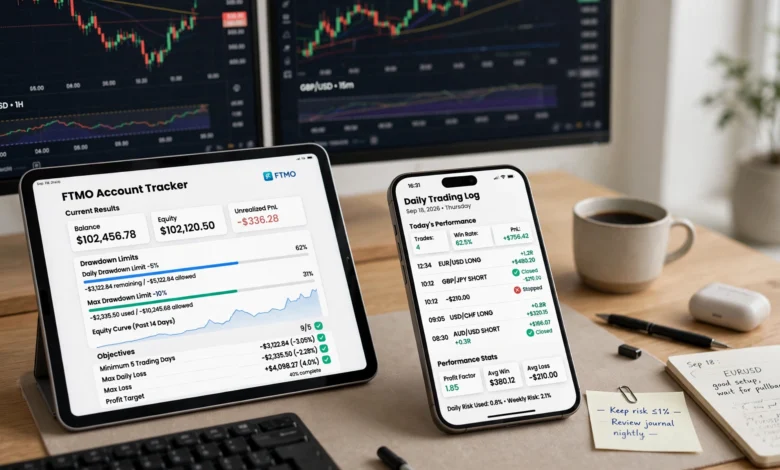
If you’re trading for a prop firm, you already know that passing the challenge is only half the battle. Staying funded is where most traders actually struggle, and that comes down to one thing: knowing your numbers. The best forex tools to track your trading performance aren’t just nice-to-haves anymore. They’re the difference between a trader who spots a bad habit before it costs them an account and one who blows through a daily loss limit without realizing what happened.
Prop firms run tight rules. Drawdown limits, daily loss caps, consistency requirements, minimum trading days. Trying to keep all of that straight in your head while also reading charts and managing emotions is a recipe for mistakes. This is exactly why trading performance tracking tools for prop firms have become such a big part of how serious traders operate today.
In this article, we’ll walk through the tools that actually help, why they matter for prop firm traders specifically, and how to pick the right one for your setup. We’ll cover trade journals, analytics dashboards, risk calculators, and a few tools that are built specifically with prop firm rules in mind. By the end, you should have a clear idea of what to add to your trading routine, whether you’re on your first evaluation or managing multiple funded accounts.
Why Tracking Performance Matters More for Prop Firm Traders
Trading your own money and trading a prop firm’s capital are two different games. With your own account, a bad week is annoying but survivable. With a prop firm, a single rule violation can end the account entirely, regardless of whether your overall strategy is profitable.
This is where performance tracking tools earn their keep. They give you visibility into things you can’t reliably track in your head:
- How close you are to your daily loss limit at any given moment
- Whether your win rate is actually improving or you’re just having a lucky streak
- Which currency pairs or sessions you perform best (and worst) in
- How your risk-reward ratio compares across different setups
- Whether you’re on pace to meet the firm’s minimum trading day or consistency rules
Without this data, you’re basically guessing. And guessing with someone else’s capital is a fast way to get your account terminated.
Key Metrics Every Prop Trader Should Be Tracking
Before jumping into specific tools, it helps to know what you’re actually trying to measure. Most forex performance tracking software will surface these metrics automatically, but you should understand what they mean.
Win Rate and Profit Factor
Win rate tells you what percentage of your trades are profitable, but it’s a bit of a trap on its own. A trader with a 40% win rate can still be very profitable if their winners are much bigger than their losers. That’s why profit factor (gross profit divided by gross loss) matters more than win rate alone.
Drawdown and Daily Loss Tracking
This is the one prop firms care about most. Most firms enforce a maximum drawdown (often 8-10% of the account) and a daily loss limit (often 4-5%). A good trading journal for prop firms should show you this in real time, not just at the end of the day when it’s too late to do anything about it.

Risk-Reward Ratio
Your average risk-reward ratio tells you whether your strategy makes mathematical sense over time. If you’re risking $100 to make $50 on most trades, you need a very high win rate just to break even.
Consistency Score
Several prop firms now require “consistency,” meaning no single trading day should account for an outsized share of your total profit. This rule catches traders who pass an evaluation with one lucky oversized trade. Tracking this manually is nearly impossible, which is why dedicated tools matter.
Best Forex Tools to Track Your Trading Performance
Here’s a rundown of the tools worth considering, grouped by what they’re best at.
1. Dedicated Trade Journals
A trade journal is the foundation of any serious tracking setup. Instead of trying to remember why you took a trade three weeks ago, you log it the moment it happens: entry, exit, position size, reasoning, and how you felt going into it.
Good trade journaling software will let you:
- Import trades automatically from MT4, MT5, or cTrader
- Tag trades by setup, session, or emotional state
- Attach screenshots of your charts at entry and exit
- Generate a running equity curve so you can see progress visually
Some of the more prop-firm-focused journals also let you track multiple accounts side by side, which matters if you’re running evaluations with more than one firm at once.
2. Analytics Dashboards
While a journal captures the raw data, an analytics dashboard turns it into something you can actually act on. These tools break your performance down by pair, time of day, day of the week, and strategy type, so you can see patterns that aren’t obvious from a simple list of trades.
For example, you might discover that your London session trades outperform your New York session trades by a wide margin, or that your Friday trades tend to lose money more often than any other day. That kind of insight is hard to get without dedicated analytics.
3. Risk and Position Size Calculators
A risk calculator does the math for you before you enter a trade, working out position size based on your account balance, stop-loss distance, and how much of your account you’re willing to risk. This sounds basic, but a surprising number of prop firm rule violations happen because a trader eyeballed their position size instead of calculating it properly.
Many of these calculators now build in prop firm rules directly, warning you if a trade would push you too close to your daily loss limit.
4. Drawdown Monitors
This is a more specialized version of a dashboard, built specifically to watch your equity against the firm’s rules in real time. Instead of checking your balance manually every few trades, a drawdown monitor gives you a live view and can alert you before you get close to a limit. For anyone managing multiple funded accounts across different firms, this kind of tool removes a lot of the mental math.
5. Trading Platform Built-In Analytics
Platforms like TradingView offer solid built-in charting, replay tools, and basic performance stats, and they’re worth using alongside a dedicated journal rather than instead of one. TradingView’s paper trading feature is also useful for testing a strategy before risking a funded account on it. You can read more about how traders use TradingView for prop firm preparation on TradingView’s official site.
6. CSV Import and Export Tools
If you’re not ready to commit to a paid journal, even a well-organized spreadsheet with manual CSV imports from your broker can work as a starting point. It’s more manual and doesn’t scale well if you’re taking a high volume of trades, but it’s better than tracking nothing at all.
7. AI-Assisted Reporting Tools
A newer category of tools now lets you ask plain-language questions about your own trading history, things like “which setups am I losing money on” or “how often do I break my rules after a losing trade.” These tools pull from your logged trade data and return charts or summaries, which can surface patterns a manual review might miss.
8. Multi-Account Management Tools
If you’re trading for more than one prop firm, keeping each account’s rules straight gets complicated fast. Multi-account tools let you view all your funded and evaluation accounts in one dashboard, with separate rule sets and drawdown limits tracked for each. This is particularly useful since firms like FTMO, FundedNext, and The5%ers all have slightly different rules around daily loss and consistency.
9. Trade Replay and Backtesting Tools
Reviewing how price moved after you exited a trade is one of the most underused ways to improve. Replay tools let you scrub through historical price action bar by bar, which is useful both for reviewing past trades and for testing new setups without risking real capital.
10. Mobile Tracking Apps
Not every trader sits at a desk all day, and a mobile app that syncs with your main journal lets you log trades, check your drawdown, and review your stats from your phone. This matters more than it sounds, especially during high-volatility news events when you need a quick gut check on your risk exposure.
How to Choose the Right Tool for Your Trading Style
Not every trader needs every tool on this list. Here’s a simple way to narrow it down:
- If you’re new to prop firm trading: Start with a basic trade journal and a risk calculator. Get in the habit of logging every trade before adding more complexity.
- If you’re managing multiple funded accounts: Prioritize a multi-account dashboard with real-time drawdown tracking across firms.
- If you’re analytically minded: Look for a platform with strong per-pair and per-session breakdowns so you can refine your edge over time.
- If you struggle with discipline: A drawdown monitor with alerts can act as a safety net, catching mistakes before they become account-ending ones.
It’s also worth checking whether a tool integrates directly with your broker or prop firm’s platform. Manual CSV exports work, but automatic syncing saves time and reduces the chance of entry errors, which matters when accuracy is the whole point of tracking in the first place.
Common Mistakes Traders Make When Tracking Performance
Even with the right tools, it’s easy to get tracking wrong. A few patterns worth avoiding:
- Only logging winning trades. This gives you a distorted picture of your actual edge.
- Tracking too many metrics at once. Focus on win rate, profit factor, drawdown, and risk-reward first. Add more once those are second nature.
- Reviewing stats only after a loss. Weekly or monthly reviews, done consistently, are far more useful than emotional check-ins after a bad day.
- Ignoring the “why.” Numbers tell you what happened, but your notes on each trade tell you why. Skipping the notes field is one of the most common journaling mistakes.
Regulatory bodies like the National Futures Association also publish general guidance on risk disclosure and trading practices, which is worth a read if you want a broader view of how risk management is framed outside the prop firm world.
Conclusion
Tracking your trading performance isn’t optional if you’re serious about staying funded with a prop firm. The best forex tools to track your trading performance give you visibility into your win rate, drawdown, risk-reward ratio, and consistency in ways that manual tracking simply can’t match.
Whether you start with a basic trade journal and risk calculator or build out a full stack with analytics dashboards and multi-account monitoring, the goal is the same: catch mistakes before they cost you an account, and build a repeatable process based on real data rather than gut feeling. Pick the tools that match where you are right now, use them consistently, and let the data guide the adjustments that actually keep you in the game.