Best Forex Brokers for Trading Gold and Oil
Compare the best forex brokers for trading gold and oil in 2026, based on regulation, spreads, leverage, and platform quality.
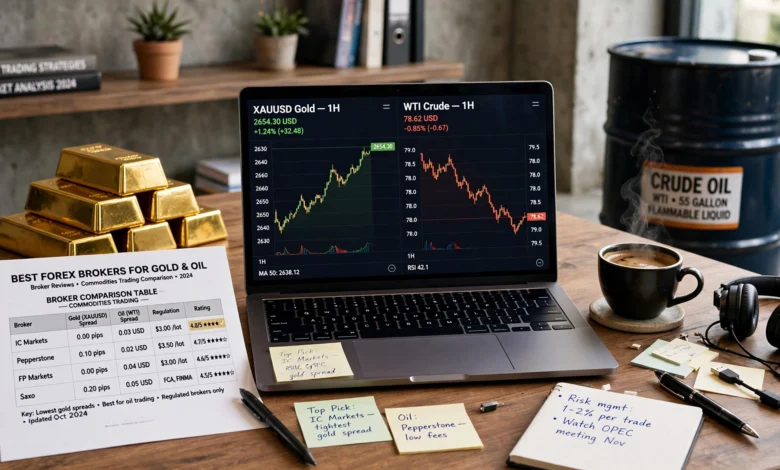
Best forex brokers for trading gold and oil share a few things in common: tight spreads on XAU/USD and crude, solid regulation, and platforms that can handle fast-moving commodity markets without freezing up at the worst possible moment. Gold and oil aren’t like trading a currency pair. They react to interest rate decisions, war headlines, OPEC meetings, and inventory reports, sometimes all in the same trading session. A broker that’s fine for EUR/USD scalping can fall apart when gold jumps $30 in ten minutes.
This guide walks through what actually matters when picking a broker for commodities, then breaks down seven brokers worth considering, based on their regulatory standing, trading costs, leverage limits, and the tools they give you for tracking gold and oil specifically. We’ll also cover the practical side: minimum deposits, account types, and what to watch out for with commission structures that look cheap on paper but add up during volatile weeks.
Whether you’re trading gold as a hedge, running short-term setups on crude oil, or building a broader commodities strategy, the broker you choose affects your bottom line just as much as your entry and exit timing. Let’s get into it.
What Makes a Broker Good for Trading Gold and Oil
Not every forex broker treats commodities as a priority. Some bolt on gold and oil CFDs almost as an afterthought, with wide spreads and clunky execution. Here’s what separates the brokers worth using from the ones to skip.
Regulation and Fund Safety
This is non-negotiable. A broker regulated by a top-tier authority, such as the UK’s FCA, Australia’s ASIC, or the US CFTC, has to meet capital requirements, keep client funds segregated, and follow strict reporting rules. Offshore brokers registered in places with light-touch oversight might offer better leverage or lower fees, but you’re taking on more risk if something goes wrong. You can check a broker’s regulatory status directly through the National Futures Association’s BASIC database if you’re trading with a US-facing firm.
Spreads and Trading Costs
Gold (XAU/USD) and oil (WTI or Brent) spreads vary a lot between brokers, and even between account types at the same broker. A standard account might show a 25-30 pip spread on gold, while a raw or ECN account offers spreads closer to 10-15 pips plus a commission. For active traders, the commission-based model usually works out cheaper, but only if you’re trading enough volume to justify it.
Leverage Options
Leverage on gold and oil is typically lower than on major currency pairs, since these assets are more volatile. Retail traders in the EU and UK are capped around 1:20 for gold under ESMA and FCA rules, while offshore brokers can offer 1:200 or higher. Higher leverage isn’t automatically better. It magnifies both gains and losses, and commodity price swings can wipe out an undermargined position fast.
Trading Platforms
MetaTrader 4 and MetaTrader 5 remain the industry standard for a reason: reliable charting, automated trading support, and broad broker compatibility. Some brokers also offer proprietary platforms or TradingView integration, which can be worth it if you want cleaner charting tools or social trading features. For gold and oil specifically, look for platforms with reliable one-click execution, since these markets can move sharply around news releases.
Range of Instruments
The strongest commodity trading brokers don’t just offer spot gold and one oil contract. They give you access to gold ETFs, gold futures, both WTI and Brent crude, and often silver, platinum, and natural gas alongside them. This matters if you want to diversify a commodities position or hedge one instrument against another.

Best Forex Brokers for Trading Gold and Oil in 2026
Here’s a closer look at seven brokers that consistently show up in independent broker comparisons for gold and oil trading, along with what makes each one worth a look.
1. AvaTrade
AvaTrade is regulated across multiple jurisdictions, including the Central Bank of Ireland, ASIC, and Japan’s FSA. It supports MT4, MT5, and its own AvaTradeGO app, all of which carry gold and oil CFDs. AvaTrade also offers a fixed-spread account option, which some gold traders prefer because it removes the guesswork around spread widening during volatile sessions.
- Fixed and floating spread account choices
- Guaranteed stop-loss orders available on select instruments
- Educational resources aimed at beginner commodity traders
2. Pepperstone
Pepperstone built its reputation on fast execution and competitive raw spreads. Its Razor account gives traders tighter pricing on gold, with a transparent per-side commission, which suits traders who run higher volumes and want predictable costs rather than a wide built-in markup.
- Access to MT4, MT5, and cTrader
- Gold, silver, platinum, copper, natural gas, and crude oil available
- Regulated by ASIC, FCA, and CySEC, among others
3. FP Markets
FP Markets is known for tight gold spreads on its Raw account, sometimes starting near zero pips before commission. It’s a solid pick for traders who prioritize execution speed and cost efficiency over a flashy proprietary platform.
- ECN-style pricing on commodities
- Wide range of account currencies
- Strong reputation for order execution speed
4. Exness
Exness stands out for flexible leverage, including options that go well beyond what’s available at EU-regulated brokers. It also offers instant withdrawals in many cases, which matters if you’re actively managing a gold or oil position and need quick access to funds.
- No fixed leverage cap on certain account types (jurisdiction-dependent)
- Low minimum deposit requirements
- Wide selection of metals and energy CFDs
5. IG
IG is one of the most established names in the industry, with a long track record and strong regulatory backing from the FCA and other top-tier bodies. It offers an extensive range of commodity CFDs, including gold, oil, and a broader spread of energy and metal markets than many competitors.
- Strong global regulatory reputation
- Deep market research and analysis tools
- Broad instrument range beyond gold and oil
6. FOREX.com
FOREX.com, part of StoneX Group, is a good fit for US-based traders since it operates as a registered entity under CFTC oversight. It supports MetaTrader 5 along with its own platform, and gold traders get access to detailed charting tools alongside integrated research.
- Regulated under US CFTC and NFA rules
- MT5 support plus proprietary platform
- Competitive raw spread account available
7. XM
XM is a multi-regulated broker with licenses across several jurisdictions, including CySEC and FSCA. It’s often chosen by traders who want a straightforward account setup with a low minimum deposit, and it offers negative balance protection, which limits downside risk during extreme volatility.
- Negative balance protection
- Multiple regulatory licenses
- Simple account opening process with low minimum deposit
How to Choose the Right Broker for Gold and Oil Trading
With several gold and oil trading brokers meeting the basic criteria, the decision usually comes down to your trading style and priorities. Consider the following before opening an account:
- Match leverage to your risk tolerance. Higher leverage isn’t a benefit if it pushes you into positions you can’t manage through a volatile session.
- Test the account type with a demo first. Spreads and execution speed can look different in live trading conditions than in marketing materials.
- Check withdrawal terms. Some brokers process withdrawals quickly; others build in delays or extra steps for certain payment methods.
- Confirm which oil contract you’re trading. WTI and Brent crude behave differently, and not every broker offers both.
- Look at the total cost, not just the spread. Commissions, overnight financing charges, and inactivity fees all affect your actual returns.
Risks of Trading Gold and Oil CFDs
Gold and oil CFDs are leveraged products, and that comes with real risk. Price swings in crude oil can be especially sharp around OPEC announcements or geopolitical events, and gold can move quickly during periods of currency instability or shifting interest rate expectations. If you’re new to commodities, it’s worth reading a plain explanation of how CFDs work from Investopedia before committing real capital, since the mechanics of leverage and margin calls trip up a lot of beginners.
It’s also worth remembering that a broker’s regulatory status doesn’t eliminate market risk. It only reduces the risk that the broker itself mishandles your funds or operates without oversight. The trading risk is still entirely yours to manage.
Frequently Asked Questions
What is the best broker for trading gold specifically?
There’s no single “best” broker for everyone. Traders focused on tight spreads often lean toward FP Markets or Pepperstone, while those who want fixed spreads and simpler risk management sometimes prefer AvaTrade. It depends on your trading frequency and strategy.
Can I trade both gold and oil with the same broker account?
Yes, most of the brokers covered here offer both gold and oil CFDs, along with other commodities like silver, natural gas, and copper, under a single account.
Is high leverage good for trading gold and oil?
Not necessarily. Higher leverage increases both potential profit and potential loss. For volatile assets like gold and oil, many experienced traders use lower leverage than the maximum available, specifically to avoid getting stopped out during normal price swings.
Do I need a different account for gold and oil compared to forex?
Usually not. Most brokers let you trade gold, oil, and currency pairs from the same trading account, though margin requirements differ by instrument.
Which regulator offers the strongest protection for traders?
Tier-1 regulators like the FCA, ASIC, and the CFTC generally offer the strongest oversight, including requirements around segregated client funds and regular audits.
Conclusion
Choosing among the best forex brokers for trading gold and oil comes down to matching a broker’s regulation, spreads, leverage limits, and platform quality to how you actually trade. AvaTrade, Pepperstone, FP Markets, Exness, IG, FOREX.com, and XM each bring something different to the table, whether that’s fixed spreads, ultra-tight ECN pricing, flexible leverage, or strong regulatory backing.
Before committing funds, test a demo account, compare live spreads during active market hours, and confirm the broker supports the specific gold and oil instruments you plan to trade. The right broker won’t guarantee profitable trades, but the wrong one can quietly erode your returns through wide spreads, poor execution, or unreliable platforms during the moments that matter most.