Best Forex Brokers for Trading US Dollar Pairs
Compare the best forex brokers for trading US Dollar pairs, including spreads, regulation, and platforms, to find a reliable fit for your trading style.
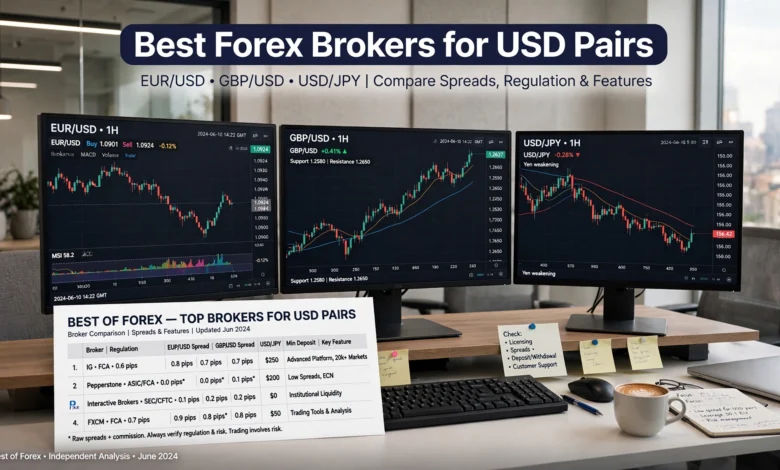
Finding the best forex brokers for trading US Dollar pairs matters more than most traders realize, because the US Dollar sits on one side of nearly 90% of all currency trades worldwide. Whether you’re working EUR/USD, USD/JPY, GBP/USD, or one of the less common USD crosses, the broker you pick affects your spreads, your execution speed, and honestly, how much of your profit actually stays in your account. A great broker with tight spreads and solid regulation can be the difference between a strategy that works on paper and one that actually pays out.
This guide breaks down what separates a strong USD pairs broker from an average one, walks through seven platforms worth considering in 2026, and explains the practical factors, regulation, spreads, leverage, and platform tools, that should shape your decision. We’ll also cover the most actively traded dollar pairs and the risks that come with trading any of them. None of this is financial advice; it’s meant to give you a clear, practical starting point so you can compare options and decide what fits your own trading plan and risk tolerance.
By the end, you should have a solid shortlist of forex brokers for USD pairs and a clear sense of what to check before opening an account with any of them.
What Makes a Broker Good for Trading US Dollar Pairs
Not every broker treats USD pairs the same way. Some specialize in majors with razor-thin spreads, while others spread themselves thin across hundreds of instruments and end up mediocre at all of them. Here’s what actually matters.
Regulation and Trust
This is the non-negotiable one. In the United States, forex brokers are regulated by the Commodity Futures Trading Commission (CFTC) and the National Futures Association (NFA), two of the strictest regulatory bodies in the industry. You can verify any broker’s registration status directly on the NFA’s BASIC system, which is a smart first step before funding any account.
Outside the US, look for brokers regulated by the FCA (UK), ASIC (Australia), or CySEC (Cyprus). A broker without credible regulation is a broker you should walk away from, no matter how good the spreads look.
Spreads and Commission Structure
Since USD pairs like EUR/USD and USD/JPY are the most liquid instruments in the world, spreads on these pairs should be tight, often between 0.0 and 0.3 pips on raw or ECN-style accounts. Some brokers charge a flat commission per lot instead of widening the spread; others do a mix of both. It’s worth calculating your actual round-turn cost rather than just comparing the advertised spread number.
Platform and Execution Quality
A broker’s trading platform needs to handle fast-moving USD pairs without slippage or lag. Look for:
- MetaTrader 4 or 5 (MT4/MT5) support for algorithmic and manual trading
- TradingView integration for charting-heavy strategies
- A proprietary web platform with clean order execution
- Mobile apps that don’t lag during high-volatility news events (like NFP releases)
Currency Pair Selection
Some brokers offer 40-plus USD pairs, others offer over 100. If you plan to trade exotic dollar crosses like USD/MXN or USD/ZAR, you’ll need a broker with a deeper pair list, not just the standard majors.


Leverage and Margin Requirements
US-regulated brokers cap leverage at 50:1 on major pairs under CFTC rules, while offshore brokers can offer 500:1 or higher. More leverage isn’t automatically better; it just means bigger swings in both directions, so match this to your own risk appetite rather than chasing the highest number available.
The 7 Best Forex Brokers for Trading US Dollar Pairs in 2026
Here’s a practical rundown of platforms that consistently show up as strong choices for trading US Dollar pairs, based on regulation, pricing, and execution quality.
1. Interactive Brokers (IBKR)
Interactive Brokers is a favorite among more serious and institutional-leaning traders, largely because of the sheer depth of its offering. IBKR gives access to over 100 major, minor, and exotic pairs, with institutional-grade spreads that can start from around 0.1 pips.
Why it stands out:
- Extremely tight spreads for high-volume traders
- Access to over 20 order types, including brackets and one-cancels-all (OCA) orders
- Strong global regulatory coverage
Best for: Active traders and those who also want stocks, options, or futures alongside forex.
2. FOREX.com
FOREX.com has built a long-standing reputation as a dedicated FX specialist, and it shows in the pricing on core USD pairs. Spreads on EUR/USD and USD/JPY can dip close to 0.0 pips on the Raw account, with a $7 per-lot commission on each side.
Why it stands out:
- Around 80 currency pairs available
- Strong charting tools and a well-built mobile app
- NFA/CFTC regulated for US clients
Best for: Traders who want a specialist forex broker rather than a multi-asset platform.
3. OANDA (OANDA US)
OANDA is known for flexible position sizing (no minimum lot size) and a clean, TradingView-powered platform with over 65 technical indicators. Its currency pair selection sits around 68 pairs, a solid middle ground between the giants and the smaller specialists.
Why it stands out:
- No minimum trade size, useful for smaller accounts
- Strong historical data and backtesting tools
- Transparent, published spread history
Best for: Newer traders who want flexibility without committing to large position sizes.
4. tastyfx (formerly IG US)
Now operating under IG Group’s US brand, tastyfx offers 85 spot forex pairs and access to multiple platforms, including MT4, MT5, TradingView, and its own proprietary interface. It’s earned recognition in recent industry awards for trust and platform quality.
Why it stands out:
- Deep platform choice rarely matched by other US brokers
- Backed by IG Group’s global reputation
- Strong educational content for newer traders
Best for: Traders who want platform flexibility and don’t mind switching between interfaces depending on the strategy.
5. NinjaTrader
NinjaTrader leans more toward active and algorithmic traders. It supports popular USD pairs like EUR/USD and includes advanced order types such as market-if-touched (MIT) and one-cancels-other (OCO), which matter a lot if you’re running semi-automated strategies.
Why it stands out:
- Built for futures and forex traders who want precision order control
- Custom indicator and strategy-building tools
- Strong community and third-party add-ons
Best for: Traders who script their own strategies or rely heavily on conditional orders.
6. Plus500US
Plus500 approaches forex through a futures lens in the US market, offering a smaller selection of about 13 currency pairs, including EUR/USD and GBP/USD. Day trading margins start competitively low, and the educational content is genuinely useful for people new to forex futures.
Why it stands out:
- Simple, beginner-friendly interface
- Low day-trading margins
- Straightforward fee structure
Best for: Beginners who want to start with the major pairs without a steep learning curve.
7. Optimus Futures
For traders who prefer trading currency futures over spot forex, Optimus Futures gives access to CME currency contracts, including EUR/USD (6E), GBP/USD (6B), and AUD/USD (6A), along with their micro versions for smaller accounts.
Why it stands out:
- Access to regulated CME futures contracts
- Micro contract sizes lower the barrier to entry
- Strong for traders who prefer exchange-traded products over OTC forex
Best for: Traders who want regulated, exchange-based exposure to dollar pairs rather than OTC spot trading.
How to Choose the Right Broker for USD Pairs
With several strong options on the table, narrowing it down comes down to a handful of practical questions.
Match the Broker to Your Trading Style
- Scalpers and day traders need the tightest spreads and fastest execution, so IBKR or FOREX.com’s raw accounts are worth a closer look.
- Swing traders care less about micro-pip spreads and more about platform tools and reliable charting, making OANDA or tastyfx solid fits.
- Algorithmic traders should prioritize platforms with strong API access and order-type flexibility, like NinjaTrader or Interactive Brokers.
Check the Real Cost of Trading
Add up spread plus commission over a realistic number of trades per month. A broker with a slightly wider spread but no commission can sometimes come out cheaper than a “raw spread” account once fees are factored in.
Test the Platform Before Committing Real Money
Every broker listed above offers a demo account. Run your actual strategy on a demo for a few weeks before funding a live account. Execution quality during high-volatility events, like Federal Reserve announcements, often looks very different from what’s advertised on the marketing page.
Confirm Deposit and Withdrawal Terms
Look at withdrawal processing times, minimum deposit requirements, and whether the broker charges inactivity fees. These details rarely make it into broker comparison charts but matter once you’re actually managing an account.
Most Traded US Dollar Pairs Explained
Since the dollar dominates global forex volume, according to the Bank for International Settlements’ Triennial Central Bank Survey, it’s worth understanding which pairs see the most activity and why.
- EUR/USD – The most liquid pair in the world, with the tightest spreads and heavy trading volume during both European and US sessions.
- USD/JPY – Popular for its sensitivity to interest rate policy differences between the Fed and the Bank of Japan.
- GBP/USD – Known for clean technical setups and strong volatility, particularly around UK economic data releases.
- USD/CHF – Often used as a relative safe-haven trade against dollar movements.
- USD/CAD – Closely tied to oil prices given Canada’s export profile, making it useful for traders tracking commodity correlations.
- AUD/USD – Sensitive to risk sentiment and commodity demand, particularly from China.
Each of these pairs behaves differently depending on the economic calendar, so it’s worth understanding the drivers behind a pair before committing capital to it, regardless of which broker you’re trading through.
Risks to Keep in Mind
Forex trading, even on major USD pairs, carries real risk. Leverage can amplify both gains and losses quickly, and volatility around news events can trigger slippage even with a well-regulated broker. A few points worth keeping in mind:
- Never risk more than you can afford to lose on any single trade
- Use stop-loss orders consistently, especially around scheduled economic releases
- Understand your broker’s margin call and stop-out policies before you need them
- Diversify your risk rather than concentrating it in a single pair or strategy
This article is for informational purposes and isn’t personalized financial advice. If you’re new to forex, it’s worth speaking with a licensed financial advisor about how currency trading fits into your broader financial picture.
Conclusion
Choosing among the best forex brokers for trading US Dollar pairs comes down to matching a platform’s regulation, spreads, and tools to how you actually trade. Interactive Brokers and FOREX.com stand out for active traders chasing tight spreads, OANDA and tastyfx offer strong flexibility for a broader range of trading styles, and NinjaTrader, Plus500US, and Optimus Futures each serve more specific niches, from algorithmic trading to futures-based exposure.
Before funding any account, verify the broker’s regulatory status, test its platform on a demo account, and calculate the real cost of trading based on your own volume and strategy. Getting this decision right up front saves a lot of frustration (and money) down the line.