Best Forex Brokers for Small Account Traders
Best forex brokers for small account traders in 2026, compared by minimum deposit, spreads, leverage, and regulation to help you trade smart.
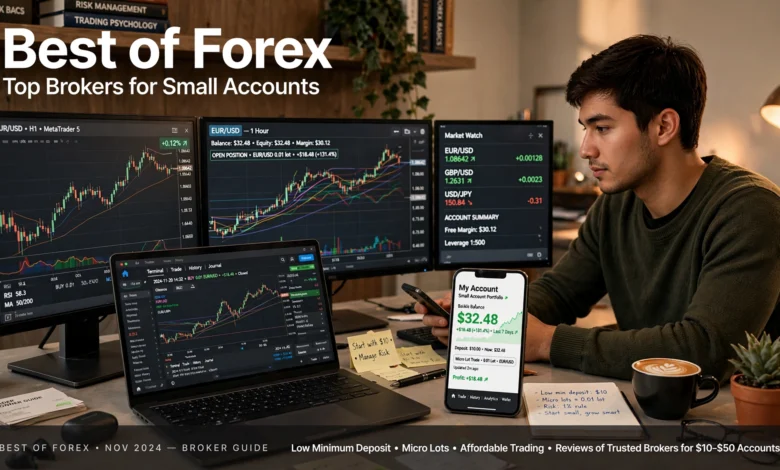
Starting with a small trading account doesn’t mean you have to settle for a second-rate broker. In fact, the opposite is true: when you’re trading with $50, $100, or even $500, the broker you choose matters more, not less. Every dollar of spread, every bit of slippage, and every hidden fee eats into a balance that doesn’t have much room to absorb mistakes.
The good news is that the retail forex industry has changed a lot over the past decade. Forex brokers for small account traders now compete hard for beginners, which means you can find tight spreads, micro and nano lot sizes, and genuinely useful education without needing thousands of dollars to open an account. The challenge isn’t finding a broker willing to take your money. It’s finding one that won’t quietly work against you through wide spreads, aggressive leverage marketing, or weak regulatory oversight.
In this guide, we’ll walk through what actually matters when you’re picking a small account forex broker, look at the traits that separate the good ones from the rest, and cover a handful of brokers that consistently show up as strong options for traders working with limited capital. We’ll also flag the mistakes that trip up small account traders most often, because avoiding those mistakes is arguably more important than which broker logo sits on your platform.
Why Your Broker Choice Matters Even More With a Small Account
When your account balance is large, a wide spread or a $10 monthly fee is annoying but survivable. When you’re trading a $200 account, that same fee could represent 5% of your capital in a single month. Small account traders operate with less margin for error, which changes the calculus of what “good broker” even means.
Here’s what changes when your account is small:
- Transaction costs matter proportionally more. A 2-pip spread on a standard lot costs the same in dollar terms regardless of account size, but it’s a much bigger percentage hit on a small balance.
- Minimum deposit requirements can lock you out entirely. Some well-known brokers require $500 or $1,000 to open a live account, which simply isn’t an option for traders starting small.
- Leverage becomes a double-edged sword. High leverage lets you control larger positions with less capital, but it also magnifies losses fast enough to wipe out a small account in a handful of bad trades.
- Lot size flexibility determines whether you can manage risk properly. Without micro or nano lots, a small account trader might be forced into position sizes that risk too much of the account on a single trade.
Key Factors to Look for in a Small Account Forex Broker
1. Low Minimum Deposit Requirements
The most obvious filter is the minimum deposit. Many forex brokers for small account traders now allow accounts to be opened with $1 to $100, which removes the biggest barrier to entry. Some brokers even offer $0 minimum deposit accounts, though it’s worth checking whether those accounts come with trade-offs like wider spreads or limited instrument access.
When comparing minimum deposits, also check:
- Whether the stated minimum applies to all account types or just a basic entry-level tier
- Deposit and withdrawal fees, which can offset the benefit of a low minimum
- Whether the broker supports your local payment method without extra conversion costs
2. Micro and Nano Lot Availability
This is arguably the single most important feature for a small account. A standard lot is 100,000 units of currency, which is far too large for most small accounts to trade responsibly. Micro lots (1,000 units) and nano lots (100 units) let you scale position sizes down to match your account, so a $1 pip movement doesn’t turn into a $10 pip movement you can’t afford.
Without access to micro or nano lots, proper risk management for a small account becomes nearly impossible, because even the smallest tradeable position might represent an outsized percentage of your balance.

3. Tight Spreads and Transparent Commissions
Spreads and commissions are the recurring cost of doing business as a trader, and they compound over time. A broker offering tight spreads on major pairs like EUR/USD or GBP/USD can save a small account trader meaningful money across dozens or hundreds of trades.
Look for:
- Raw or ECN-style spread accounts if you trade frequently, even if they come with a small commission
- Standard accounts with no commission but slightly wider spreads if you trade less often
- Clear, published spread data rather than vague “from 0.0 pips” marketing claims
4. Regulation and Fund Safety
Regulation isn’t glamorous, but it’s the difference between a broker that has to answer to an authority and one that doesn’t. Reputable regulators include the Financial Conduct Authority (FCA) in the UK, the Australian Securities and Investments Commission (ASIC), the Cyprus Securities and Exchange Commission (CySEC), and the National Futures Association (NFA) in the United States.
A well-regulated broker typically offers:
- Segregated client funds, kept separate from company operating capital
- Negative balance protection, so you can’t lose more than you deposit
- A formal complaints and compensation process if something goes wrong
You can check a broker’s regulatory status directly through the FCA’s Financial Services Register before opening an account, which takes a few minutes and can save you a lot of trouble later.
5. Reasonable, Not Reckless, Leverage
High leverage is often marketed as a benefit, and technically it is, since it lets you control a larger position with less margin. But for a small account, excessive leverage is more often a trap than a tool. A trader using 500:1 leverage on a $200 account can blow through their entire balance in a handful of pips if a trade goes wrong.
Look for brokers that offer flexible leverage settings, so you can choose something conservative like 10:1 or 30:1 while you’re building experience, rather than being locked into the maximum leverage by default.
6. Educational Resources and Demo Accounts
Small account traders are often newer traders, and the brokers that serve this group well tend to invest in education. A solid demo account with a realistic price feed lets you practice strategies without risking real money, and webinars, tutorials, or economic calendars can shorten the learning curve considerably.
7. Platform Reliability and Execution Speed
A broker can check every box above and still fail you if the trading platform lags or the execution is slow during volatile news events. Look for brokers offering MetaTrader 4, MetaTrader 5, or cTrader, which are widely tested platforms with strong track records for stability, charting tools, and automated trading support.
Best Forex Brokers for Small Account Traders
Below are brokers that consistently rank well among small account and beginner traders, based on minimum deposit requirements, lot size flexibility, spread competitiveness, and regulatory standing. Always confirm current terms directly with the broker before opening an account, since fees and conditions change.
1. Exness
Exness is well known for its unlimited leverage options on certain account types and extremely low minimum deposits, sometimes as low as $1. It supports micro and nano lot trading, which makes it a strong fit for traders starting with a very small balance. It’s regulated by multiple authorities including the FCA and CySEC, though the exact regulatory entity you’re assigned depends on your country of residence.
2. XM
XM has built a reputation around accessibility for beginners, with a $5 minimum deposit and micro lot trading available across its account types. It also offers generous educational content, including live webinars and market analysis, which suits traders who are still learning the ropes alongside managing a small account.
3. IC Markets
IC Markets is generally aimed at more experienced traders due to its ECN-style raw spread accounts, but it’s worth including here because of its consistently tight spreads and fast execution. The minimum deposit is around $200, which is higher than some competitors, but the cost savings from tight spreads can matter a lot to active small account traders over time.
4. Pepperstone
Pepperstone is regulated by both the FCA and ASIC, and it offers a low minimum deposit alongside competitive spreads on major currency pairs. It supports both MetaTrader and cTrader platforms, giving small account traders flexibility in how they want to execute and manage trades.
5. FBS
FBS is popular among traders in regions where accessibility and low deposit requirements matter most, with minimum deposits as low as $1 on certain account types. It supports micro accounts specifically designed for small balances, though traders should pay close attention to which regulatory entity applies to their account.
6. RoboForex
RoboForex offers cent accounts, which denominate trading in cents rather than dollars, making it easier for very small account traders to size positions appropriately. This account structure is particularly useful for traders who want to practice with real money but at a much smaller financial commitment than a standard account requires.
7. OctaFX
OctaFX is known for a $25 minimum deposit and a straightforward account structure with no hidden fees on deposits or withdrawals. It also runs regular deposit bonus promotions, which can give small account traders a bit of extra trading capital, though it’s worth reading the terms carefully since bonuses often come with withdrawal conditions attached.
Common Mistakes Small Account Traders Make
Even with the right broker, small account trading comes with pitfalls that have nothing to do with which platform you’re using.
- Overleveraging positions. Just because a broker offers 500:1 leverage doesn’t mean you should use it. Sizing positions too aggressively is the fastest way to lose a small account.
- Ignoring the spread-to-balance ratio. A 2-pip spread might be negligible on a $10,000 account and painful on a $100 account. Always think about costs as a percentage of your balance, not just in pip terms.
- Chasing bonuses over broker quality. A deposit bonus is nice, but it shouldn’t be the deciding factor if the broker’s spreads, execution, or regulation are weak.
- Trading without a stop loss. Small accounts have even less room to recover from an unmanaged loss, making disciplined risk management non-negotiable.
- Withdrawing too early or too often. Constant small withdrawals combined with withdrawal fees can quietly erode a small account’s growth over time.
How to Choose the Right Broker for Your Situation
There’s no single “best” broker for everyone, because the right choice depends on your trading style, location, and goals. A trader who plans to make dozens of trades a week should weight spreads and commissions heavily. A trader who’s still learning should weight education and demo account quality more. And a trader in a region with limited regulatory coverage should weight the broker’s international regulatory standing carefully.
Before committing, it’s worth doing a short checklist:
- Confirm the minimum deposit fits comfortably within your budget, with room to spare
- Verify the broker’s regulatory license through the relevant regulator’s public register
- Test the platform with a demo account before funding it with real money
- Read the fine print on any deposit bonuses or promotions
- Check withdrawal times and fees, not just deposit terms
For a deeper look at how currency markets function day to day, the Investopedia forex trading guide is a solid, independent resource for building foundational knowledge before you commit real capital.
Final Thoughts on Trading Forex With a Small Account
Trading with a small account is a completely legitimate way to start, as long as you go in with realistic expectations. Growth will be slower in dollar terms, and that’s fine. What matters most in the early stages isn’t how much money you’re making, it’s whether you’re building good habits around risk management, position sizing, and broker selection. A broker with low minimum deposits, micro or nano lot access, tight spreads, and solid regulation gives you the best possible foundation to build those habits without unnecessary costs working against you.
Conclusion
Choosing the right broker is one of the most overlooked decisions small account traders make, yet it directly affects how much of your limited capital actually stays in your pocket. The best forex brokers for small account traders combine low minimum deposits, micro or nano lot flexibility, competitive spreads, and solid regulatory oversight, giving you room to learn and grow without excessive costs working against you.
Brokers like Exness, XM, IC Markets, Pepperstone, FBS, RoboForex, and OctaFX each offer something different depending on your trading style and location, so the right pick comes down to matching their strengths to your specific needs. Whatever broker you choose, treat regulation, transparent costs, and sensible leverage as non-negotiable, since those three factors will protect your account far more than any bonus or marketing promise ever will.