Best Forex Brokers for Trading Exotic Currency Pairs: 10 Proven Picks for 2026
Compare the best forex brokers for trading exotic currency pairs based on regulation, spreads, liquidity access, and platform tools.
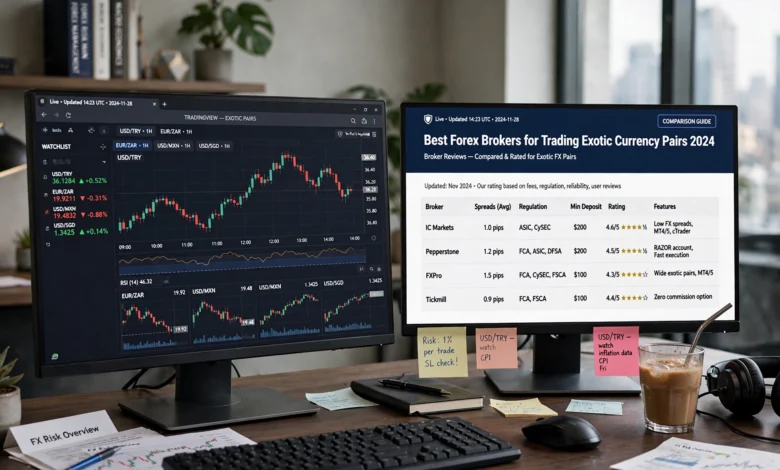
Best forex brokers for trading exotic currency pairs are not the same brokers that top the list for majors like EUR/USD. Exotic pairs, things like USD/TRY, USD/ZAR, or EUR/HUF, behave differently. They move on local politics and central bank surprises, they trade with far less volume, and they punish a broker with poor pricing or shaky execution much faster than a major pair ever would. If you have decided to add exotics to your trading plan, the broker you pick matters more than usual.
This guide walks through what actually separates a good exotic-pairs broker from an average one, then looks at ten firms that consistently show up in that conversation for good reason. You will also find a breakdown of what exotic currency pairs are, the specific risks they carry, and a few practical habits that make trading them less painful. None of this is personalized financial advice. Currency trading, and exotic pairs especially, carries real risk of loss, and you should treat any broker comparison as a starting point for your own research rather than a final answer.
By the end, you should have a clear sense of which factors to weigh, whether that is regulation, spread quality, the actual number of exotic pairs on offer, or platform reliability during volatile news events, and a shortlist of brokers worth looking at more closely.
What Are Exotic Currency Pairs?
An exotic currency pair combines one major global currency, usually the US dollar, euro, or British pound, with the currency of a smaller or developing economy. Common examples include USD/TRY (Turkish lira), USD/ZAR (South African rand), USD/MXN (Mexican peso), EUR/HUF (Hungarian forint), and USD/THB (Thai baht).
What sets these pairs apart from majors and minors is not just the exotic label. It comes down to three practical things:
- Lower liquidity. Fewer institutions and traders are active in these pairs at any given moment, which means it can take longer to fill an order at your intended price.
- Wider spreads. Exotic pairs are less liquid and less frequently traded than major and minor pairs, which leads to higher volatility and wider spreads, so the cost of entering and exiting a trade is noticeably higher than with EUR/USD or USD/JPY.
- Sharper volatility around local news. Because these currencies are tied to smaller economies, a central bank decision, election result, or commodity price swing in that country can move the pair dramatically in a short window.
That combination is exactly why the broker matters so much here. A firm that offers tight spreads and deep books on EUR/USD can still offer thin, unreliable pricing on USD/ZAR.
Why Your Broker Choice Matters More for Exotic Pairs
With major pairs, most regulated brokers offer broadly similar pricing because the interbank market for EUR/USD is deep and competitive. Exotic pairs flip that dynamic. Liquidity is thinner, so the broker’s own liquidity providers and internal pricing model have a much bigger effect on what you actually pay.
A few consequences worth knowing before you commit to a broker:
- Spreads vary wildly between brokers on the same pair. One broker’s USD/TRY spread might be two or three times wider than another’s, even though both quote the same “exotic” category.
- Overnight financing costs (swaps) differ a lot. Emerging market currencies often carry high interest rate differentials, so rollover fees on exotic pairs can eat into returns faster than most traders expect.
- Execution quality during news events is uneven. Some brokers widen spreads or slow execution sharply during high-impact news on smaller economies, which is precisely when exotic-pair traders are most active.
- Not every broker actually offers the pair you want. Plenty of firms cap their offering at 40 to 60 pairs and skip the more obscure exotics entirely.
Key Factors to Consider When Choosing a Forex Broker for Exotic Pairs
Before comparing specific firms, it helps to know what you are actually screening for. These are the factors that matter most.


Regulation and Trust
Start here, always. A broker regulated by a recognized authority, such as the FCA in the UK, ASIC in Australia, CySEC in Cyprus, or the NFA and CFTC in the United States, is required to segregate client funds and follow capital adequacy rules. Trading exotic pairs already carries elevated risk; you do not want to layer counterparty risk on top of that by using an unregulated or loosely regulated broker. According to the Bank for International Settlements’ triennial survey data, global forex markets turn over more than $7.5 trillion per day, a figure that underscores how dramatically liquidity varies between major and exotic pairs, and that gap is exactly why oversight matters more once you step outside the majors.
Range of Exotic Pairs Offered
Some brokers advertise “exotic pairs” but only carry a handful, like USD/MXN or USD/ZAR. If your strategy depends on trading less common currencies such as the Hungarian forint, Polish zloty, or Thai baht, check the actual instrument list before opening an account rather than assuming it is included.
Spread and Commission Structure
Compare typical spreads on the specific exotic pairs you plan to trade, not just the broker’s headline EUR/USD number. Ask whether the broker uses a fixed spread, a variable spread, or a raw spread plus commission model, since each behaves differently when volatility spikes.
Liquidity and Execution Quality
Look for brokers that route orders through multiple liquidity providers or operate an ECN/STP model, since this tends to produce more consistent fills on thinly traded pairs. Slippage is a normal part of exotic-pair trading, but a well-connected broker keeps it manageable.
Leverage and Margin Requirements
Regulators typically cap leverage lower on exotic pairs than on majors because of the added volatility. Confirm the specific margin requirement for each exotic pair you intend to trade, since it can differ significantly from the broker’s standard leverage figure.
Platform Tools and Risk Management Features
Guaranteed stop losses, negative balance protection, and real-time margin alerts matter more with exotic pairs because gaps and fast moves are more common. A platform that handles these smoothly can meaningfully reduce your downside.
Research and Local Market Coverage
Because exotic pairs are driven by developments in specific countries, a broker with dedicated research on emerging market currencies, interest rate calendars, and political risk commentary gives you a real edge over one that only covers the majors.
10 Best Forex Brokers for Trading Exotic Currency Pairs
Here is a look at ten brokers that are consistently recognized for their currency pair range, regulatory standing, and execution quality. Always verify current account terms, available pairs, and regulatory status directly with the broker, since offerings change and vary by region.
1. IG
IG is one of the most widely recognized names in the industry and a good starting point for exotic pair trading. IG took first place in ForexBrokers.com’s 2026 Annual Awards as the best overall forex broker, with 100 available currency pairs and the ability to trade CFDs and forex options. IG holds nearly a dozen regulatory licenses and is the only forex broker regulated in both Switzerland and the United States, which gives it a strong trust profile for traders who want oversight alongside a broad exotic pair selection.
2. CMC Markets
If sheer pair variety is your priority, CMC Markets is hard to beat. CMC Markets offers a total of 316 currency pairs and won the ForexBrokers.com 2026 Annual Award for most currency pairs, a distinction it has held for five consecutive years. That depth of coverage makes it a strong option for traders who want access to less common exotics beyond the usual USD/TRY or USD/ZAR.
3. Interactive Brokers (IBKR)
Interactive Brokers is built for traders who want institutional-grade infrastructure. IBKR presents an extensive range of over 100 major, minor, and exotic forex pairs, surpassing nearly all leading alternatives aside from CMC Markets. Spreads are competitive with low commission-based pricing, and the broker connects to over 130 global exchanges, alongside more third-party research than most other brokers provide. This combination of research and execution depth suits traders who treat exotic pairs as part of a broader, more analytical strategy.
4. IC Markets
IC Markets built its reputation on raw pricing and execution speed, which matters a great deal once spreads widen on exotic pairs. It is the largest forex broker by trading volume, averaging $1.35 trillion in monthly forex volume during the second quarter of 2025. That scale generally translates into tighter, more reliable pricing even on less liquid pairs, and the broker’s ECN model appeals to algorithmic and high-frequency traders who need consistent fills.
5. FOREX.com
FOREX.com pairs a large instrument list with competitive costs. It offers 80 currency pairs with some of the most competitive fees in the industry, including EUR/USD spreads as low as 0.0 pips and a $7 commission per $100,000 traded. For traders who want a well-established, heavily regulated broker with solid exotic pair coverage without the complexity of an institutional platform, it is a reasonable middle ground.
6. tastyfx
tastyfx has built a strong reputation for both pair range and execution speed in the US market. US traders using tastyfx can access 86 major, minor, and cross currency pairs, exceeding what other brokers operating in the country offer, with an average trade execution time of 17 milliseconds. That speed matters when an exotic pair gaps on a surprise rate decision or political headline.
7. Fusion Markets
Fusion Markets has positioned itself as a low-cost option without cutting corners on execution. Its Zero account pricing runs lower than the industry average commission, and independent testing has shown consistently tight spreads even on that account type. For cost-conscious traders who plan to trade exotics frequently, keeping transaction costs down matters as much as the spread itself.
8. Pepperstone
Pepperstone is well known for its raw ECN pricing and strong regulatory footprint across the FCA, ASIC, and CySEC, along with a solid range of exotic pairs including several African and Eastern European currencies. Its Razor account structure suits traders who want transparent, commission-based pricing rather than pure spread markup, which tends to be more cost-effective on wider-spread exotic pairs.
9. OANDA
OANDA is a long-standing name in the industry with a straightforward fractional pip pricing model and a solid selection of exotic pairs, including several Scandinavian and Latin American currencies. It is regulated in multiple major jurisdictions and offers detailed historical spread data, which is genuinely useful when you are trying to judge how a specific exotic pair actually trades before committing capital.
10. Saxo Bank
Saxo Bank sits at the premium end of the market, with a currency pair list that extends well into less common exotics and a platform built for serious, research-driven traders. It suits traders who want private banking-level infrastructure alongside a wide instrument range, though account minimums and fee structures tend to be higher than the retail-focused brokers on this list.
Risks of Trading Exotic Currency Pairs
Exotic pairs are attractive because of the volatility, but that same volatility is a genuine risk, not just an opportunity. Keep these points in mind:
- Wide spreads eat into small moves. Exotic currency markets are less efficient than major pairs due to lower trading volumes and market opacity, and this inefficiency leads to wider spreads and higher transaction costs that can eat up potential gains.
- Liquidity can dry up fast. Fewer traders are active in exotic pairs at any given time, meaning there is less depth in the order book, so large orders can move the price against you more than expected.
- Political and economic shocks hit harder. A surprise interest rate move, a currency peg change, or unexpected political instability can send an exotic pair sharply in one direction with little warning.
- Overnight costs can be steep. Interest rate differentials between, say, the US dollar and the Turkish lira, tend to be large, which makes holding exotic positions overnight considerably more expensive than holding a major pair.
- Slippage is more common. Orders can fill at a noticeably different price than expected, particularly around news releases or thin trading hours.
Tips for Trading Exotic Currency Pairs Successfully
- Start small. Trade smaller position sizes than you would on a major pair until you understand how a specific exotic behaves.
- Watch the economic calendar for that specific country, not just the usual US, UK, or Eurozone releases.
- Use limit orders rather than market orders where possible, since this gives you more control over your entry price in a thinly traded market.
- Check swap rates before holding overnight. A trade that looks profitable intraday can lose money quickly to financing costs if held for several days.
- Trade during the pair’s most active hours. Exotic pairs tied to specific regions tend to have narrower, more predictable spreads during their local trading session.
- Keep a wider stop loss than you would on a major pair, but size your position down accordingly so your overall risk stays the same.
Frequently Asked Questions
What exactly counts as an exotic currency pair? Any pair pairing a major currency with the currency of a smaller or developing economy. Investopedia’s overview of exotic currencies is a useful reference if you want a deeper definition and examples beyond what’s covered here.
What is the safest way to trade exotic currency pairs? Choose a well-regulated broker, size your positions conservatively, and avoid holding exotic positions through major local news events unless that is specifically part of your strategy.
Which exotic pairs are the most commonly traded? USD/TRY, USD/ZAR, USD/MXN, EUR/HUF, and USD/THB are among the more actively traded exotics, though liquidity still lags well behind the majors.
Do all forex brokers offer exotic currency pairs? No. Many brokers focus on majors and minors and only carry a handful of exotics, so it is worth confirming the specific pair list before opening an account.
Is leverage lower on exotic pairs? Usually, yes. Most regulators require brokers to apply reduced leverage on exotic pairs compared with majors, reflecting their higher volatility.
Conclusion
Choosing among the best forex brokers for trading exotic currency pairs comes down to a handful of concrete checks: solid regulation, a genuinely wide selection of exotic pairs rather than just a few token ones, competitive spreads on the specific pairs you plan to trade, reliable execution during volatile news events, and risk management tools that account for the sharper moves exotics are known for.
Brokers like IG, CMC Markets, Interactive Brokers, IC Markets, and the others covered here each bring a different strength to the table, whether that is sheer pair variety, raw pricing, or research depth, so the right one depends on how you actually plan to trade. Whatever broker you choose, treat exotic currency pairs with the extra caution they deserve, since their volatility cuts both ways, and always confirm current terms, spreads, and regulatory status directly with the broker before committing real capital.