Best Forex Trading Books for Long-Term Success
Best forex trading books for long-term success, covering psychology, risk management, and strategy from traders who built lasting careers.
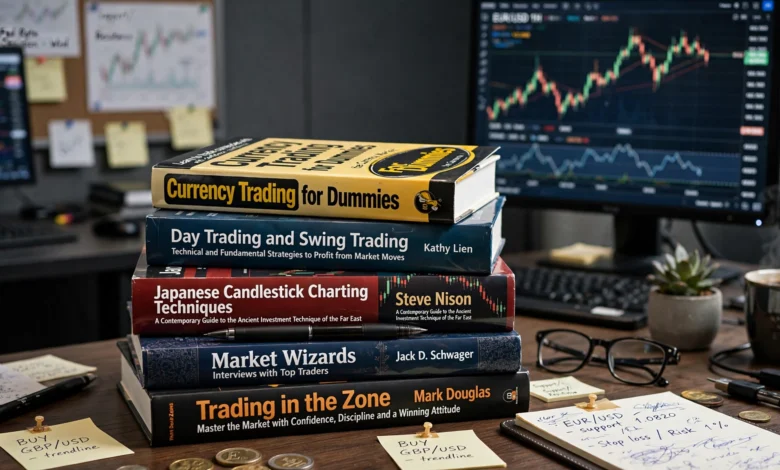
If you’ve spent any time searching for the best forex trading books, you’ve probably noticed the same ten titles showing up on every list, usually with a short blurb and no real explanation of why they matter. That’s not particularly useful when you’re trying to build a career, not just win a few trades. Books written for long-term success in forex are different from the ones that promise quick profits. They focus on things that don’t expire: how markets actually behave, how to manage risk so one bad week doesn’t wipe you out, and how to keep your head straight when a trade goes against you.
This guide pulls together seven books that traders and educators keep coming back to, years after publication. Some cover trading psychology, some cover technical analysis, and a couple focus almost entirely on risk management, which is the part most beginners skip and later regret. Instead of just naming titles, each section explains what the book actually teaches, who it’s best suited for, and how to apply it rather than just read it. By the end, you’ll have a short list you can work through in order, plus a way to turn that reading into habits that stick.
Why Books Still Matter in the Age of Trading Apps and YouTube Gurus
It’s fair to ask why anyone should read a book when there’s endless free content on YouTube and Twitter. The honest answer is that most of that content is built for engagement, not education. A 12-minute video can show you a setup, but it rarely explains the reasoning deeply enough for you to adapt it when conditions change.
Forex trading books written by people with decades of market experience go through editing, revision, and fact-checking that a video script usually doesn’t. They also tend to cover full systems of thought rather than isolated tips. A book on trading psychology, for example, walks you through why fear and greed distort decisions, not just that they do. That kind of depth is harder to get from short-form content, and it’s exactly what separates traders who last from traders who blow up their account in year one.
That said, books work best as a foundation, not a replacement for practice. Reading about risk management won’t protect your capital. Applying it on a demo account, then a small live account, will.
What Makes a Forex Trading Book Worth Your Time
Before jumping into the list, it helps to know what separates a genuinely useful book from one that’s just recycled content padded into 300 pages. Look for these traits:
- Focus on principles over predictions. Good books teach you how to think about price movement and risk, not which currency pair will rally next month.
- Coverage of trading psychology. Almost every experienced trader agrees that mindset, not strategy, is what determines long-term outcomes.
- Practical risk management advice, including position sizing, stop-loss placement, and how much of your account to risk per trade.
- Real examples, ideally from the author’s own trading history or documented case studies, not hypothetical charts.
- A clear target audience. A book written for beginners will frustrate an experienced trader, and a book written for professionals will overwhelm someone just starting out.
With that in mind, here are the books that consistently meet these standards.
The Best Forex Trading Books for Long-Term Success
1. Trading in the Zone – Mark Douglas
If you only read one book on trading psychology, most professional traders would point you toward this one. Douglas argues that consistent profitability has almost nothing to do with predicting the market correctly and everything to do with managing your own behavior. He breaks down the mental habits that cause traders to hesitate, overtrade, or abandon a plan the moment it gets uncomfortable.
This book isn’t specific to forex, but its lessons apply directly to currency trading, where volatility and leverage make emotional discipline even more important. It’s a strong pick for anyone who already understands basic trading mechanics but keeps sabotaging their own results.

Best for: Traders who have a strategy but struggle to follow it consistently.
2. Currency Trading for Dummies – Kathleen Brooks and Brian Dolan
Despite the title, this is a genuinely well-organized introduction to how the forex market works. It covers the mechanics of currency pairs, how economic data moves prices, the role of central banks, and the basics of both technical and fundamental analysis. It’s written for people with no prior trading background, so if you’re brand new to forex, this is a sensible starting point before jumping into more advanced material.
What makes it useful for long-term success rather than just beginner knowledge is the section on risk management, which explains position sizing and leverage in plain language. Too many new traders skip this part of their education entirely, then get wiped out by a single oversized position.
Best for: Complete beginners who need a structured overview before anything else.
3. Japanese Candlestick Charting Techniques – Steve Nison
Nison is widely credited with introducing candlestick charting to Western traders, and this book is still the reference point for anyone who wants to understand price action rather than rely purely on indicators. It explains how candlestick patterns form, what they suggest about buyer and seller behavior, and how to combine them with other forms of technical analysis.
This isn’t a light read. It’s detailed and occasionally dense, but the depth is exactly why it holds up decades after publication. If you want to understand price charts at a level beyond “this pattern usually means the price goes up,” this book delivers that.
Best for: Traders who want a serious, lasting understanding of price action.
4. Day Trading and Swing Trading the Currency Market – Kathy Lien
Kathy Lien is a well-known currency analyst, and this book reflects her experience combining fundamental and technical analysis rather than relying on one or the other. She explains how economic indicators, interest rate decisions, and geopolitical events move currency pairs, then pairs that with practical chart-reading techniques.
What sets this book apart is its balance. Many trading books lean heavily into either pure technicals or pure fundamentals. Lien treats them as complementary tools, which mirrors how professional traders actually operate. The book also includes trade examples that walk through her reasoning step by step, which is useful for seeing theory applied in practice.
Best for: Traders who want to combine fundamental and technical approaches for long-term success rather than picking one side.
5. Market Wizards and The New Market Wizards – Jack Schwager
These two books, part of a longer series, are collections of interviews with top-performing traders across different markets, including forex. Rather than teaching a single method, Schwager lets the traders explain their own paths, mistakes, and turning points in their own words.
What comes through repeatedly is that these traders succeeded through discipline, risk control, and years of refining their approach, not through finding a secret indicator. Reading multiple perspectives back to back also helps you understand that there’s no single “correct” way to trade. There are many paths, and the common thread is discipline.
Best for: Traders who want to see how different successful people actually think, rather than following one prescribed system.
6. The Little Book of Currency Trading – Kathy Lien
This is a shorter, more accessible companion to Lien’s other work, aimed at people who want a practical introduction without the density of a full technical manual. It covers the basics of currency correlations, how to read economic reports, and simple strategies for both short-term and longer-term trades.
It works well as a bridge between beginner material and more advanced books. If Currency Trading for Dummies feels too basic but Nison’s candlestick book feels too technical, this sits comfortably in between.
Best for: Traders who’ve learned the basics and want a practical next step before tackling denser material.
7. Forex for Beginners – Anna Coulling
Coulling’s book stands out because of its focus on risk, both market risk and financial risk, rather than jumping straight into strategy. She spends real time explaining how to assess how much risk a given trade actually carries and how that should shape position size, something many beginner-focused books gloss over.
It also serves as an entry point into her more advanced work on volume and price analysis, so if this book resonates with you, there’s a clear next step in her catalog.
Best for: New traders who want risk management built into their foundation from day one, rather than added as an afterthought.
How to Read These Books Strategically, Not Just Once
Reading a trading book cover to cover and moving on is the least effective way to use it. These books are reference material as much as they are one-time reads. Here’s a more effective approach:
- Read once for the big picture. Get through the whole book without stopping to take detailed notes. You’re building context first.
- Reread with a notebook. On the second pass, write down specific rules, checklists, or frameworks you plan to test.
- Apply immediately on a demo account. Concepts like stop-loss placement or reading candlestick patterns only become real once you’ve watched them play out on a live chart, even a simulated one.
- Revisit after a losing streak. Books on trading psychology in particular read very differently after you’ve actually experienced the emotions they describe. A concept that seemed obvious on first read often lands much harder the second time.
This kind of active reading is what turns a book into a lasting habit rather than a forgotten shelf item.
Building a Long-Term Study Plan Around These Books
If you want to structure your reading rather than pick titles at random, a rough order might look like this:
- Month 1: Currency Trading for Dummies, to build a foundation.
- Month 2: Forex for Beginners, to establish risk management habits early.
- Month 3: Japanese Candlestick Charting Techniques, to start reading price action properly.
- Month 4: Day Trading and Swing Trading the Currency Market, to combine fundamentals with technicals.
- Month 5: Trading in the Zone, once you have enough live trading experience to relate to the psychology being described.
- Month 6: Market Wizards, as a way to zoom out and see how different professionals built their careers.
This isn’t a rigid schedule, and there’s no harm in adjusting it based on where your own knowledge gaps are. The point is to pair each book with a stage of your development rather than binge-reading everything in a week and retaining very little.
Common Mistakes Traders Make When Learning From Books
A few patterns show up again and again among traders who read widely but still struggle:
- Collecting books instead of applying them. Owning ten trading books doesn’t make you a better trader if you haven’t tested a single concept from any of them.
- Skipping the psychology and risk chapters. These sections often feel less exciting than strategy chapters, but they’re usually the most important for long-term survival.
- Treating every strategy as universal. A technique that worked for the author in a specific market condition won’t necessarily hold up in every environment. Context matters.
- Never revisiting older material. Your understanding of a book changes as your experience grows. What felt irrelevant on a first read might become essential after a year of live trading.
Being aware of these patterns is half the battle. The other half is actually building habits around applying what you read, which ties back to the study plan above.
Books vs Courses vs Mentors: Where Reading Fits In
Books aren’t the only way to learn, and it’s worth being honest about their limits. Courses often provide structure and accountability that a book can’t, and mentors can give feedback on your actual trades, which no book will ever do. According to Investopedia’s overview of forex trading education, a well-rounded education usually combines multiple formats rather than relying on just one.
Where books genuinely shine is depth and permanence. A course might get updated or discontinued, and a mentor’s availability is limited, but a well-written book stays exactly as useful ten years later as it was on release day. Communities like the Babypips forex trading school are a good complement to book learning, since they offer a more interactive way to test concepts and ask questions as you go.
The most effective approach tends to combine all three: books for depth and long-term principles, a structured course or community for interactive learning, and practice, ideally with a mentor or peer group, for feedback on your actual decisions.
Conclusion
The best forex trading books for long-term success aren’t the ones promising fast profits or a secret system. They’re the ones that build a real foundation in risk management, market structure, and trading psychology, the three things that actually separate traders who last from traders who don’t.
Working through titles like Trading in the Zone, Currency Trading for Dummies, and Japanese Candlestick Charting Techniques gives you a well-rounded education that holds up regardless of market conditions. The real value comes from reading actively, testing what you learn, and revisiting these books as your experience grows, rather than treating them as a one-time checklist to get through.