Best Forex Economic Calendars for Traders, 2026
Best forex economic calendars compared for accuracy, speed, and usability, helping traders track events and plan smarter trades.
A forex economic calendar is one of those tools that separates traders who plan from traders who react. If you’ve ever watched a currency pair swing 100 pips in a matter of minutes and wondered what just happened, chances are an economic release triggered it. Interest rate decisions, jobs reports, inflation data, GDP figures: these numbers move markets, and a good economic calendar for forex tells you exactly when they’re coming.
The problem is that not all calendars are built the same way. Some are cluttered with ads and irrelevant data. Others lag behind the actual release time by several seconds, which in fast markets can cost real money. Some don’t let you filter by currency or impact level, so you’re stuck scrolling through low-tier releases from countries you don’t even trade.
In this article, we’ll walk through what makes a forex economic calendar genuinely useful, compare the tools that traders actually rely on day to day, and cover how to read and use calendar data without getting overwhelmed by it. Whether you’re a scalper who needs second-by-second precision or a swing trader planning your week, there’s a calendar setup here that fits your style. Let’s get into it.
What Is a Forex Economic Calendar and Why It Matters
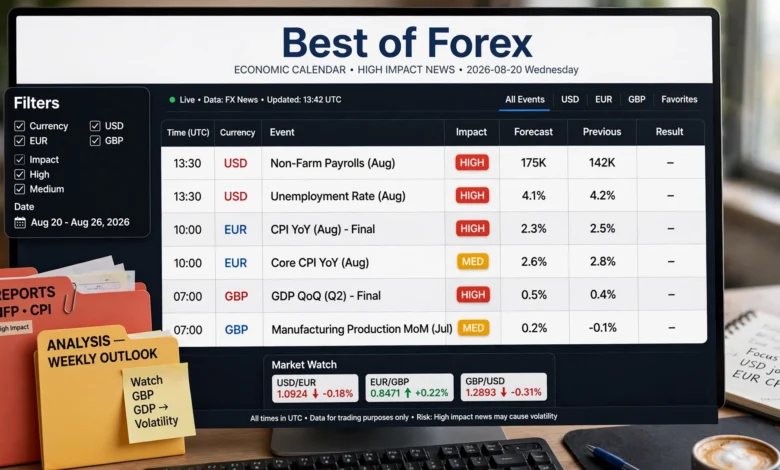
A forex economic calendar is a schedule of upcoming economic data releases, central bank announcements, and other market-moving events, organized by date, time, and country. Think of it as a heads-up display for the news that actually affects currency prices.
Every calendar entry usually includes:
- Event name (e.g., Non-Farm Payrolls, CPI, Interest Rate Decision)
- Country or currency affected
- Scheduled release time, adjusted to your local time zone
- Impact level (low, medium, or high)
- Forecast, previous, and actual figures once released
Why does this matter so much? Because currency prices are driven largely by expectations versus reality. If analysts forecast a 0.2% rise in inflation and the actual number comes in at 0.5%, that surprise can send a currency pair sharply higher or lower within seconds. Traders who track an economic calendar know when to expect volatility and can prepare, whether that means entering a position, tightening a stop loss, or simply staying out of the market until the dust settles.
For a deeper explanation of how macroeconomic indicators influence currency values, Investopedia’s guide to economic indicators is a solid starting point.
Key Features to Look For in a Forex Economic Calendar
Before comparing specific tools, it helps to know what actually separates a great forex economic calendar from a mediocre one.
1. Real-Time Data Accuracy
Speed matters. A calendar that updates figures a few seconds late might not sound like a big deal, but in a fast-moving market, those seconds are the difference between catching a move and chasing it. Look for calendars known for pulling data directly from official government and central bank sources rather than secondary feeds.

2. Customizable Filters
A good economic calendar lets you filter by:
- Currency or country
- Impact level (so you’re not distracted by minor releases)
- Event type (interest rates, employment, inflation, trade balance, etc.)
This is especially useful if you only trade a handful of pairs, like EUR/USD or GBP/JPY, and don’t need to see every data point from every economy in the world.
3. Time Zone Conversion
Nothing ruins a trading plan faster than misreading a release time. The best calendars automatically convert event times to your local time zone, removing the guesswork.
4. Historical Data and Context
Seeing the previous reading alongside the forecast gives you context. If a central bank has been raising rates for six straight meetings, a calendar that shows that trend helps you anticipate the tone of the next announcement rather than reacting blindly.
5. Mobile Access
Markets don’t wait for you to be at your desk. A calendar with a solid mobile app or responsive website means you can check upcoming releases from anywhere.
6. Volatility Indicators
Some calendars go a step further and show expected volatility or historical price reaction for a given event, which helps with risk management before the release even happens.
Top Forex Economic Calendars Traders Actually Use
Here’s a rundown of the platforms that consistently show up as favorites among retail and professional traders alike.
1. Forex Factory Calendar
Forex Factory’s calendar is arguably the most widely used free forex economic calendar on the internet, and for good reason. It’s simple, fast, and has an active trader community that comments on events in real time, which can give you a sense of market sentiment before and after a release.
Strengths:
- Clean, no-frills interface
- Strong filtering by currency and impact
- Active community discussion threads on each event
Drawbacks:
- Ads can be distracting on the free version
- Design feels dated compared to newer platforms
2. Investing.com Economic Calendar
Investing.com offers one of the most comprehensive economic calendars for forex traders, covering not just currencies but also commodities, stocks, and bonds. It’s a good option if you trade across multiple asset classes and want everything in one place.
Strengths:
- Extensive global coverage
- Customizable notifications via app
- Historical data charts for each indicator
Drawbacks:
- Interface can feel cluttered on mobile
- Some premium features are locked behind a subscription
3. DailyFX Economic Calendar
Backed by IG Group, DailyFX combines its forex economic calendar with analysis and commentary from experienced market strategists. This makes it a strong pick for traders who want context alongside raw data.
Strengths:
- Analyst commentary tied to major releases
- Clean, modern design
- Reliable data sourcing
Drawbacks:
- Fewer minor-tier events listed compared to Forex Factory
- Some content requires account registration
4. TradingView Economic Calendar
TradingView built its calendar directly into its charting platform, which is a major convenience if you already use it for technical analysis. You can view upcoming events without leaving your chart window.
Strengths:
- Seamless integration with charts
- Community sentiment indicators
- Works well across desktop and mobile
Drawbacks:
- Full features require a paid TradingView plan
- Slightly less detailed than dedicated calendar sites
5. FXStreet Economic Calendar
FXStreet has built a reputation for accuracy and speed, particularly around high-impact releases like Non-Farm Payrolls and central bank rate decisions. Many professional traders use it specifically because of how quickly actual figures populate after release.
Strengths:
- Fast data updates
- Detailed event descriptions explaining why each release matters
- Available in multiple languages
Drawbacks:
- Layout can feel busy for beginners
- Mobile app has mixed reviews on stability
6. MarketWatch Economic Calendar
A good option for traders who like their calendar paired with financial news coverage. MarketWatch pulls in broader market context, which can be useful if you’re trying to understand how forex events connect to equities and bonds.
Strengths:
- Strong integration with financial news
- Straightforward, readable layout
- Free to use with no paywall on calendar data
Drawbacks:
- Less specialized for pure forex trading
- Fewer customization options than dedicated forex sites
7. Broker-Provided Calendars (MT4/MT5 Plugins)
Many forex brokers now offer built-in economic calendar widgets directly inside MetaTrader 4 or MetaTrader 5. These aren’t always the most feature-rich, but the convenience of having the calendar right next to your charts without switching tabs is a genuine advantage for active traders.
Strengths:
- No need to switch platforms while trading
- Often synced with your account’s local time settings
- Usually free with your trading account
Drawbacks:
- Data depth varies significantly by broker
- Fewer analytical tools compared to standalone calendar sites
How to Use a Forex Economic Calendar Effectively
Having a good forex economic calendar open isn’t enough on its own. Here’s how experienced traders actually build it into their routine.
- Check the calendar every morning. Before placing any trades, scan the day’s high-impact events for the currencies you trade. This takes less than five minutes and can save you from getting caught off guard.
- Focus on high-impact events first. Not every release moves the market. Filtering out low-impact data keeps you focused on what actually matters.
- Note forecast versus previous figures. A wide gap between the two often signals higher potential volatility.
- Avoid opening new trades minutes before major releases. Spreads widen and price can gap unpredictably around high-impact news. Many traders step aside 15-30 minutes before and after a big release.
- Use it for both entries and risk management. If you’re already in a trade and a major release is coming up, the calendar tells you when to consider tightening your stop loss or reducing position size.
- Cross-reference multiple calendars occasionally. Data feeds can differ slightly. If a number looks unusual, checking a second source takes seconds and confirms you’re reacting to accurate information.
Free vs Paid Forex Economic Calendars
Most traders can get by perfectly well with free tools, and honestly, the free versions of Forex Factory, Investing.com, and DailyFX cover the vast majority of what’s needed. Where paid calendars earn their keep is in extra features like:
- Custom alert systems with SMS or push notifications
- API access for automated trading systems
- Deeper historical data sets for backtesting
- Ad-free, streamlined interfaces
If you’re a discretionary trader checking the calendar a few times a day, free is usually enough. If you’re building automated strategies around news events or trading at a professional level, a paid or API-based calendar might be worth the cost.
Common Mistakes Traders Make With Economic Calendars
- Ignoring time zone settings, leading to missed or mistimed trades
- Trading every single event, including low-impact ones that barely move price
- Not adjusting position size ahead of known high-volatility releases
- Relying on a single source without ever double-checking a surprising figure
- Forgetting recurring events, like monthly jobs reports or quarterly GDP releases, that follow a predictable schedule
Avoiding these mistakes is often just a matter of building the habit of checking your forex economic calendar consistently, rather than only glancing at it when something unexpected happens.
Conclusion
A reliable forex economic calendar is one of the simplest yet most effective tools a trader can add to their routine. It won’t predict the market for you, but it tells you when the biggest opportunities and risks are likely to show up, which is half the battle in forex trading.
Whether you lean toward Forex Factory’s community-driven simplicity, Investing.com’s broad coverage, or a broker-integrated MT4 widget, the right choice comes down to how you trade and how much detail you actually need. The traders who consistently perform well aren’t the ones with the fanciest calendar; they’re the ones who actually check it, understand the events on it, and plan their trades around it.