Best Forex Brokers with Negative Balance Protection in 2026
Forex Brokers with Negative Balance Protection: compare the safest regulated options that shield your account from owing money.
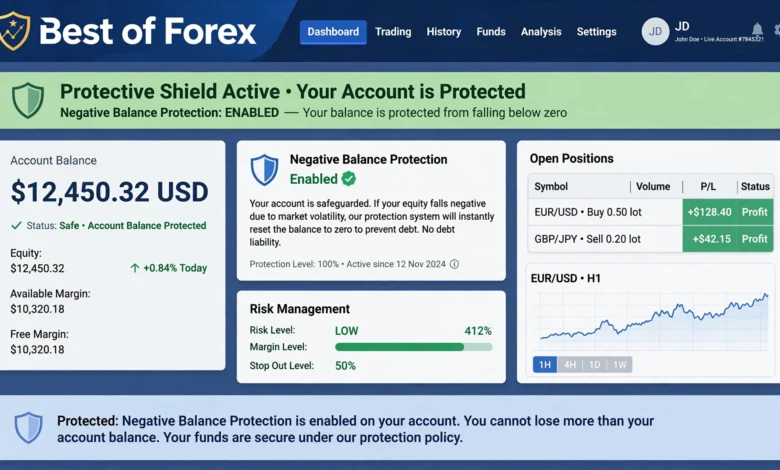
Trading currencies always carries risk, but there’s one risk most beginners never think about until it’s too late: owing your broker money. A sudden market gap, a flash crash, or a surprise central bank announcement can blow through your stop-loss and leave your account balance in the negative. That’s where forex brokers with negative balance protection come in. This safeguard caps your maximum loss at whatever you deposited, so a bad trade never turns into a debt collector’s phone call.
This guide walks through what negative balance protection actually means, why regulators started requiring it, and which brokers do it well. We’ll look at the regulatory bodies that mandate this protection, the trading conditions that go along with it, and a practical checklist for picking a broker that won’t leave you exposed.
Whether you’re a new trader building your first account or an experienced one reviewing your risk setup, understanding this feature matters just as much as spreads or leverage. By the end, you’ll know exactly what to look for and which names in the industry have built a reputation for keeping traders financially safe, even when markets move violently.
What Is Negative Balance Protection?
Negative balance protection (NBP) is a broker policy that automatically resets your trading account to zero if a trade or series of trades pushes your balance below it. Without this protection, extreme volatility, such as the Swiss Franc shock in January 2015, can wipe out a deposit and leave the trader owing the broker additional funds.
In simple terms:
- Without NBP: If your account has $500 and a fast market move causes $700 in losses before your position closes, you now owe the broker $200.
- With NBP: The broker absorbs that $200 shortfall. Your account balance never goes below zero.
This matters most for traders who use high leverage, since leveraged positions can move far beyond the account’s equity in seconds during a liquidity gap.
Why Negative Balance Protection Matters
Protecting Retail Traders from Catastrophic Loss
The core purpose of negative balance protection is simple risk containment. Retail traders, unlike institutional players, typically don’t have the capital reserves to absorb an unexpected debt. A single black swan event, like a surprise interest rate decision or a geopolitical shock, can trigger slippage that no stop-loss order can fully prevent. Negative balance protection ensures that the worst-case scenario is losing your deposit, not losing more than you put in.
Regulatory Push Behind the Feature
Following several high-profile market shocks, regulators across major jurisdictions began requiring brokers to offer this protection to retail clients. Some of the most influential rules came from:
- The European Securities and Markets Authority (ESMA), which mandated negative balance protection for retail forex and CFD accounts across the EU as part of its 2018 product intervention measures. You can review ESMA’s official guidance on retail investor protections directly on their site: ESMA product intervention measures.
- The UK’s Financial Conduct Authority (FCA), which adopted similar rules for CFD and forex providers operating under UK law, detailed in their official policy statement: FCA CFD and forex rules.
- The Australian Securities and Investments Commission (ASIC) and Cyprus Securities and Exchange Commission (CySEC) followed with comparable requirements for brokers licensed in their regions.
Because of these rules, most reputable brokers serving EU, UK, and Australian clients now offer negative balance protection by default, not as an optional add-on.


How Negative Balance Protection Works in Practice
Automatic Balance Reset
When a losing trade closes and pushes the account below zero, the broker’s back-office system automatically credits the account back to zero. This happens without any action needed from the trader. There’s usually no paperwork or claim process involved, since it’s built into the broker’s risk engine.
Stop-Out Levels and Margin Calls
Negative balance protection works alongside, not instead of, standard risk controls like margin calls and stop-out levels. Most brokers will automatically close positions once your margin level hits a certain threshold (commonly between 20% and 50%), well before a total account wipeout. NBP acts as a final backstop for the rare cases when even automated liquidation can’t happen fast enough, usually during severe slippage or a market gap over a weekend.
Applies Mostly to Retail Accounts
It’s worth noting that negative balance protection typically applies only to retail trading accounts, not professional or institutional ones. Traders who opt for “professional” classification (often to access higher leverage) usually give up this protection in the process. If you’re weighing that trade-off, it’s worth reading the fine print carefully before switching account types.
Key Features to Look for in a Broker Offering Negative Balance Protection
Choosing a broker isn’t just about whether they offer NBP. A handful of related factors determine how safe and reliable your trading experience will actually be.
- Regulatory Licensing – Confirm the broker is regulated by a tier-1 authority such as the FCA, ASIC, CySEC, or a similar body. Regulation is what makes negative balance protection enforceable rather than just a marketing claim.
- Segregated Client Funds – Your trading capital should be held in accounts separate from the broker’s operating funds, protecting your money if the company runs into financial trouble.
- Transparent Execution Model – Look for brokers that clearly state whether they operate as an ECN, STP, or market maker, since execution quality affects how often slippage actually occurs.
- Leverage Limits – Regulated brokers often cap leverage for retail accounts (commonly 30:1 for major currency pairs under ESMA and FCA rules), which reduces the odds of hitting a negative balance in the first place.
- Compensation Schemes – Some jurisdictions back client funds with investor compensation schemes, adding another layer of protection beyond NBP itself.
- Track Record – A broker’s history during past volatility events, like the 2015 Swiss Franc unpegging, tells you a lot about how well their risk systems actually hold up under pressure.
7 Best Forex Brokers with Negative Balance Protection
Below is an overview of brokers commonly recognized in the industry for combining strong regulation with reliable negative balance protection. This list is meant as a starting point for your own research, not a personal recommendation, since the right broker depends on your trading style, location, and account needs.
1. IG Group
IG is one of the longest-standing names in the forex and CFD space, regulated by the FCA in the UK along with several other major authorities worldwide. It offers negative balance protection to retail clients and is known for deep liquidity and a wide range of tradable instruments.
2. eToro
eToro combines forex trading with social and copy-trading features, and it applies negative balance protection to retail accounts under its European and UK regulatory licenses. It’s a popular pick for traders who want to follow or mirror experienced traders while still keeping downside risk capped.
3. XM
XM holds licenses in multiple jurisdictions, including CySEC and ASIC, and applies negative balance protection across its retail account types. It’s often chosen by traders who want a broad selection of account types alongside solid risk safeguards.
4. Pepperstone
Pepperstone is regulated by the FCA, ASIC, and CySEC, and it offers negative balance protection on retail accounts. The broker is well known among traders who prioritize fast execution and tight spreads on major pairs.
5. AvaTrade
AvaTrade operates under several regulatory umbrellas, including CySEC and ASIC, and provides negative balance protection as a standard feature for retail clients. It also offers a range of educational tools, which makes it a reasonable option for newer traders learning to manage risk.
6. FxPro
FxPro is regulated by the FCA and CySEC and includes negative balance protection for retail accounts. The broker is frequently mentioned for its variety of execution technologies and multi-platform support.
7. Admirals (formerly Admiral Markets)
Admirals is regulated across the EU, UK, and Australia and applies negative balance protection to its retail trading accounts. It’s known for offering a large library of trading tools alongside standard forex and CFD products.
Important note: Broker offerings, regulatory status, and account terms change over time. Always verify current licensing and protection policies directly on the broker’s official website or through the relevant regulator’s public register before opening an account.
How to Verify a Broker’s Negative Balance Protection Claim
Marketing pages can say a lot. Before trusting a broker with your capital, take these steps to confirm the protection is real and enforceable.
- Check the regulator’s register. Search the broker’s license number on the FCA, ASIC, or CySEC public database to confirm it’s active and covers the entity you’d actually be trading with.
- Read the account terms, not just the homepage. Negative balance protection is sometimes limited to certain account types or excluded for accounts classified as “professional.”
- Look for it in the risk disclosure document. Regulated brokers are usually required to disclose this protection in their formal legal documentation, not just promotional copy.
- Ask support directly. A quick chat with customer support asking how NBP has been applied historically, and how quickly balances get reset, can reveal a lot about how the policy actually works day to day.
Negative Balance Protection vs. Other Risk Management Tools
It helps to see how negative balance protection fits alongside other tools traders use to manage downside risk.
| Tool | What It Does | Limitation |
|---|---|---|
| Negative Balance Protection | Caps total loss at deposited funds | Doesn’t prevent losses, only limits them |
| Stop-Loss Orders | Closes a trade at a set price | Can suffer slippage during fast markets |
| Guaranteed Stop-Loss Orders | Closes at the exact set price for a fee | Usually comes with an added cost |
| Margin Call Alerts | Warns when equity nears the stop-out level | Requires the trader to act quickly |
| Position Sizing | Limits exposure per trade | Requires discipline and planning |
Negative balance protection isn’t a substitute for sound risk management. It’s a final safety net that works best when paired with proper position sizing and realistic leverage use.
Common Misconceptions About Negative Balance Protection
“It Means I Can’t Lose Money”
Negative balance protection only prevents your account from going below zero. You can still lose your entire deposit. It’s a limit on the downside, not a guarantee against losses.
“All Brokers Offer It”
Not every broker does, and offshore or unregulated brokers may not honor this protection consistently, even if it’s advertised. This is one of the clearest reasons regulatory status matters as much as the feature itself.
“It Applies to Every Account Type”
As mentioned earlier, professional accounts and some non-retail account categories often lose this protection in exchange for higher leverage limits. If you’re unsure which category you fall under, it’s worth clarifying with the broker directly.
Final Checklist Before Choosing a Broker
- Confirm the broker holds an active license with a recognized regulator (FCA, ASIC, CySEC, or similar).
- Verify that negative balance protection applies specifically to your account type.
- Check that client funds are held in segregated accounts.
- Review the broker’s leverage caps for the instruments you plan to trade.
- Read recent user feedback about how the broker performed during high-volatility events.
- Test the broker’s customer support responsiveness before committing significant capital.
Conclusion
Negative balance protection has become one of the most important safeguards a retail forex trader can look for, since it draws a hard line under how much you can lose, no matter how volatile the market gets. Choosing among forex brokers with negative balance protection means looking beyond the marketing claims and confirming real regulatory backing, segregated funds, and clear account terms.
Names like IG, eToro, XM, Pepperstone, AvaTrade, FxPro, and Admirals have built reputations around combining solid regulation with this protection, but policies and terms shift over time, so always check current details directly with the broker or its regulator before opening an account. Pairing this safeguard with sound position sizing and realistic leverage keeps your trading risk where it belongs: limited to what you’ve chosen to put on the line.