Crypto Funded Accounts: 7 Best Prop Firms (Proven Picks for 2026)
Compare 7 prop firms offering crypto funded accounts by profit split, drawdown rules, payout speed, and fees before you pay for any challenge.
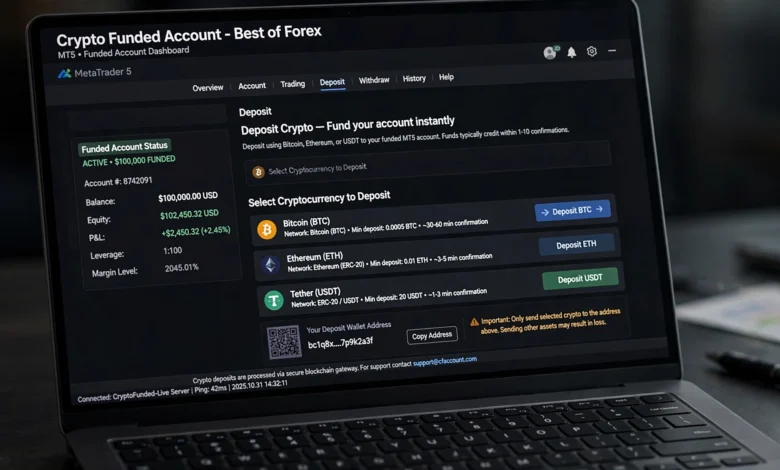
Crypto funded accounts let a trader work with a firm’s capital instead of a personal balance, and in 2026 more crypto prop firms than ever are competing for that business. The pitch is simple: pay a one-time evaluation fee, reach a profit target inside strict risk limits, and keep a large share of the profits from a funded account that can run from $5,000 to $200,000 or more. The reality is more demanding. Industry commentary cited by altFINS suggests only a small minority of challenge buyers ever reach a payout, and dozens of firms folded during the 2024–2025 shakeout. That is why the firm you choose matters nearly as much as the strategy you trade.
This guide compares seven of the best prop firms for crypto traders: Breakout, HyroTrader, Crypto Fund Trader, FundedNext, FTMO, BrightFunded, and Goat Funded Trader. Each profile covers the profit split, drawdown design, payout speed, execution quality, and the small rules that quietly fail accounts. Before the reviews, you will find a plain-language explanation of how the evaluation model works, plus a checklist you can apply to any firm, including ones not listed here. Figures come from the firms’ own materials and published third-party reviews gathered in October 2026. Terms change often, so confirm live conditions on each official site before spending money.
What Are Crypto Funded Accounts and How Do They Work?
Crypto funded accounts are trading accounts a proprietary firm provides after you pass a structured test. You pay an evaluation fee, trade toward a target without breaking the firm’s loss limits, and if you pass, you receive access to a funded account where you keep a profit split, typically between 70% and 90%. As Kraken’s educational guide explains, you risk only the one-time entry fee, because the firm carries the market exposure.
One point is worth stating early: most funded accounts are simulated or signal-based. The firm pays real money based on your performance, but you are usually not holding real positions on an exchange. Kraken’s own materials say this directly about its prop products, and the same logic applies to many competitors. The payouts are real; the trading capital is a modeled allocation.
Stage 1: The Evaluation Challenge
You pick an account size, often from $5,000 up to $200,000, and a challenge format. Three formats dominate the market:
- One-step challenge: a single profit target, usually around 8% to 12%.
- Two-step challenge: a smaller target split across two phases, for example roughly 10% then 5%.
- Instant funding: no test at all, in exchange for a higher fee and often a lower starting split.
Many 2026 operators have dropped calendar deadlines, though some replace them with minimum trading days. Read this part of the rulebook carefully, because a lower target is often paired with tighter risk limits.
Stage 2: The Funded Account and Payouts
After you pass, the same risk rules continue, and profits are shared according to the firm’s split. Crypto-focused firms frequently pay in stablecoins such as USDT or USDC, and payout windows range from on-demand requests to 12–24 hours to fixed 14-day cycles. Check for first-payout minimums, waiting periods, and identity verification, because delays at this step cause more frustration than almost anything else.
Stage 3: Scaling Plans
Strong, consistent results can unlock larger balances. A common structure raises the account by about 25% after a set number of months once you hit a cumulative profit milestone. Some firms advertise ceilings of $1 million or more. Treat these as long-term upside, not a reason to choose a firm today, since the early rules decide whether you ever get there.
How We Judged the Best Crypto Prop Firms
To separate marketing from substance, each firm was compared on the same criteria that top-ranking comparison pages from Kraken, CoinGecko, and altFINS emphasize. Here is the framework:


- Operating history and payout record: Firms with a verifiable track record rank higher than newcomers with strong ads.
- Profit split: The 2026 baseline sits around 80%, although a high split paired with harsh rules can be worth less than a lower split with clean ones.
- Drawdown type: Static drawdown stays fixed to your starting balance, while trailing drawdown rises with your peak equity and can shrink your room after a good day.
- Daily loss limit: A second way to fail, usually 2% to 5% of the balance.
- Payout speed and method: Stablecoin payouts within 24 hours are now common among crypto-native firms.
- Execution quality: Real exchange order books versus simulated CFD feeds.
- Fees and refund policy: Treat the fee as money at risk, not a deposit.
- Rule friction: Consistency rules, stop-loss timing rules, weekend restrictions, and news limits.
Quick Comparison of the Best Crypto Funded Accounts
The table below summarizes headline figures from published reviews. Numbers are approximate and vary by plan.
| Firm | Typical Account Range | Profit Split | Payout Speed | Execution Style |
|---|---|---|---|---|
| Breakout (Kraken) | Up to $200K | 80%, upgradable to 90% | On-demand, about 24h | Simulated, Kraken-backed |
| HyroTrader | $5K to $200K, scaling toward $1M | 70% rising to 90% | 12–24h | Bybit-linked |
| Crypto Fund Trader | $5K to $200K or more | 80% to 90% | 8–24h | Bybit partnership |
| FundedNext | Up to $200K for crypto, wider for other assets | 80% to 95% on select plans | About 24h | CFD platforms |
| FTMO | $10K to $200K, scaling to $2M | 80% to 90% | Bi-weekly | CFD platforms |
| BrightFunded | Up to $200K plus scaling | 80% to 100% | 4–8h | CFD platforms |
| Goat Funded Trader | Up to $800K | Up to 100% | Two-day guarantee | CFD platforms |
7 Best Prop Firms Offering Crypto Funded Accounts
1. Breakout: Best Exchange-Backed Option for Crypto Funded Accounts
Breakout is a crypto-native platform that Kraken acquired in September 2025, which made it the first top-tier regulated exchange to buy its way into proprietary trading. According to Kraken’s guide, Breakout runs its own terminal across web, iOS, and Android, offers 50+ simulated crypto pairs, and allows up to 5x leverage on BTC and ETH and 2x on altcoins.
The standout feature is the lack of friction. Kraken states there are no consistency rules, no minimum trading days, and no time limits across its prop products. Payouts are on-demand in USDC, and the default split is 80%, upgradable to 90% at checkout. Drawdown is static, roughly 3% to 6% depending on the plan.
Strengths: parent-company credibility, simple rulebook, fast payouts.
Watch-outs: the fee is non-refundable once trading begins, the pair list is narrower than some rivals, and Kraken’s disclosures note the program is unregulated. Because Kraken owns the platform, its own comparison page is not neutral, so cross-check with independent reviews.
2. HyroTrader: Best Crypto-First Prop Firm With Exchange Execution
HyroTrader built its reputation by linking funded accounts to a live exchange through an API, so fills reference a real order book. Based on altFINS’ review, the firm offers one-step and two-step challenges, with entry fees from about $59 for a $5,000 account up to roughly $999 for $200,000, and a reported fee refund with your first payout.
The one-step path asks for a 10% target with a 4% daily and 6% overall loss limit. The two-step version loosens the limits to roughly 5% daily and 10% total. The profit split starts at 70% and can grow to 90% through time and performance, with scaling toward $1 million possible for consistent traders.
Strengths: real exchange execution, deep perpetual-futures menu, high leverage, stablecoin payouts in 12–24 hours.
Watch-outs: the starting split sits below the common 80% mark, and altFINS reports a 40% consistency rule during evaluation, a per-trade risk cap, and mandatory stop-loss timing. These rules suit disciplined traders but punish one oversized winner.
3. Crypto Fund Trader: Best Specialist for Altcoin Variety
Crypto Fund Trader has operated since late 2022 and ranks among the longest-running dedicated crypto prop firms. Several 2026 comparison pages credit it with a Bybit partnership, access to more than 700 tradeable assets, and stablecoin payouts in roughly 8 to 24 hours. Account tiers start at $5,000, and published splits run from about 80% to 90%.
Maximum account size varies between sources, with figures ranging from $200,000 to $300,000, so check the current plan page. Leverage is described as conservative and not customizable, which suits risk-aware traders but frustrates anyone who wants aggressive sizing.
Strengths: crypto-only focus, wide asset list, fast payouts, multi-year history.
Watch-outs: fixed leverage and stricter risk settings than multi-asset firms.
4. FundedNext: Best Multi-Asset Firm With Crypto Access
FundedNext launched in 2022 and became known for sharing profits during the challenge itself, which lets traders earn while proving consistency. Per altFINS, standard splits run 80% to 90%, with up to 95% on certain structures, and scaling ceilings reach into the millions for non-crypto assets.
Crypto access runs through familiar platforms such as MT4, MT5, cTrader, and Match-Trader. That convenience comes with limits: altFINS notes that its crypto instruments are fewer than at crypto-native firms and that crypto trading pauses on weekends, which mismatches the 24/7 market.
Strengths: generous splits, strong brand reach, educational resources, instant-funding style options.
Watch-outs: weekend closures, smaller crypto pair list, lower crypto leverage.
5. FTMO: Best Established Name With Crypto Alongside Forex
FTMO has operated for more than a decade, and that longevity is its biggest trust signal in an industry that lost dozens of firms recently. The classic two-phase evaluation asks for about 10% in Phase 1 and 5% in Phase 2, with a 5% daily loss limit and a 10% maximum drawdown, according to altFINS. Accounts run from $10,000 to $200,000, with scaling toward $2 million.
Crypto is available as one asset class among many, not the main focus. Payouts are bi-weekly, splits move from 80% to 90%, and automated trading is permitted on supported platforms.
Strengths: deep operating history, strong education, multi-platform support.
Watch-outs: higher fees, stricter evaluation rules, and a smaller crypto menu than specialists.
6. BrightFunded: Best for Fast Payouts and US Traders
BrightFunded, based in Amsterdam, appeals to traders who want quick withdrawals and broad access. Published reviews cite payout windows of 4 to 8 hours, splits that can reach 100%, an infinite scaling plan, and an offering of 35+ crypto pairs such as Solana, XRP, Dogecoin, and Litecoin. altFINS also lists it among firms that accept US traders, which many competitors do not.
The trade-off is structural. Execution is CFD-based rather than routed to a real exchange, and the firm has a shorter payout history than veterans. Treat it as a candidate to test with a small account first.
Strengths: very fast payouts, wide pair list, flexible scaling.
Watch-outs: simulated CFD pricing, shorter track record.
7. Goat Funded Trader: Best for Large Account Ceilings
Goat Funded Trader targets ambitious traders with simulated accounts up to $800,000, splits reaching 100%, unlimited time, and explicit permission for news trading and weekend holds, based on altFINS’ summary. The firm also advertises a two-day payout guarantee with compensation if withdrawals arrive late.
Its rulebook looks trader-friendly on paper, but the pair selection leans toward forex, and execution is CFD-based. Verify the live terms, since big headline numbers deserve extra scrutiny.
Strengths: high ceiling, relaxed trading-style rules, payout guarantee.
Watch-outs: forex-oriented instrument list, shorter history.
Real Exchange Execution vs. CFD Simulation for Crypto Funded Accounts
The biggest structural difference among crypto funded accounts is how prices are produced. Firms tied to exchanges such as Bybit or Kraken pull quotes from live order books. CFD-based firms build prices from aggregated feeds, which can sometimes create wicks or spreads that differ from a real exchange.
For scalpers who rely on tight stops, that gap is worth paying attention to. For swing traders holding positions for days, it usually matters less than drawdown type and weekend rules. Neither model is automatically better, but you should know which one you are buying before you pay the fee.
How to Choose the Right Crypto Prop Firm for Your Trading Style
Match the rulebook to the way you actually trade, not to the loudest advertisement.
- Scalpers: prioritize real exchange execution, tight spreads, and no minimum-hold-time rules. HyroTrader and Breakout fit this profile.
- Swing traders: look for static drawdown, weekend holding permitted, and no strict deadlines. Breakout, Goat Funded Trader, and FTMO swing-style accounts are worth comparing.
- Algorithmic traders: confirm that bots and expert advisors are allowed, and check how stop-loss timing rules apply to automated orders.
- Beginners: start with the smallest account size, clear rules, and a refundable or low fee. A $5,000 account teaches the rules at minimal cost.
- US-based traders: availability is the first filter. Confirm your region is supported before paying anything.
Common Mistakes That Blow Crypto Funded Accounts
Crypto’s volatility is the main reason challenges fail. A Q1 2026 analysis published by Track360 estimated that daily drawdown breaches during volatility spikes account for roughly two-thirds of failures on crypto tracks, though that figure comes from a single secondary source and should be treated as indicative. The usual causes are predictable:
- Oversizing early to hit the target faster.
- Revenge trading after a loss, which stacks risk into one session.
- Ignoring consistency rules, so one big winner invalidates the pass.
- Misreading the daily reset time, which varies by firm.
- Delaying identity verification, which stalls the first payout.
- Buying the largest account first instead of testing a small one.
Red Flags to Watch When Comparing Crypto Prop Firms
Before paying for any challenge, scan for warning signs:
- No verifiable payout history or very limited operating time.
- Vague or frequently changing rules.
- Payout terms of 30 days or longer, which is slow for crypto.
- Heavy pressure to buy through discount codes and affiliate promotions.
- Reviews that read like advertisements. Note that many comparison pages, including some cited here, earn affiliate commissions.
Frequently Asked Questions About Crypto Funded Accounts
Are crypto prop firms legit?
Some are, but quality varies sharply. Kraken’s disclosures state that its own prop program is unregulated, and altFINS reports that dozens of firms failed between 2024 and 2025. Judge each firm on payout history, rule clarity, and operating time.
Do I trade real money with crypto funded accounts?
Usually not. Most accounts are simulated or signal-based, while payouts are paid in real funds based on your results.
What is the difference between static and trailing drawdown?
Static drawdown is fixed from your starting balance. A 3% static limit on a $10,000 account ends the account at $9,700 equity. Trailing drawdown follows your highest equity, so your buffer can shrink after profitable days.
How much does a crypto funded account cost?
Entry fees scale with account size. Published ranges run from under $100 for a $5,000 account to around $1,000 for $200,000. Refund policies differ, so read them first.
Can I use trading bots?
Often yes, but policies vary. Confirm the rule on automation and any stop-loss timing requirements before running code.
Are prop firm payouts taxable?
In most jurisdictions payouts count as income. Speak with a qualified accountant, since this guide is not tax advice.
Conclusion
Choosing among crypto funded accounts comes down to matching a firm’s rulebook to your trading style rather than chasing the highest advertised split: Breakout offers the simplest rules and exchange-parent credibility, HyroTrader and Crypto Fund Trader serve crypto-first traders who value exchange-linked execution and wide pair lists, FundedNext and FTMO bring established brands with crypto as one asset class among many, and BrightFunded and Goat Funded Trader suit traders who want speed, flexibility, or a high account ceiling at the cost of CFD-based pricing.
Whichever you pick, start with a small account, learn the drawdown and consistency rules before risking the fee, verify live terms on the official site, and remember that trading carries substantial risk and nothing here is financial advice.